
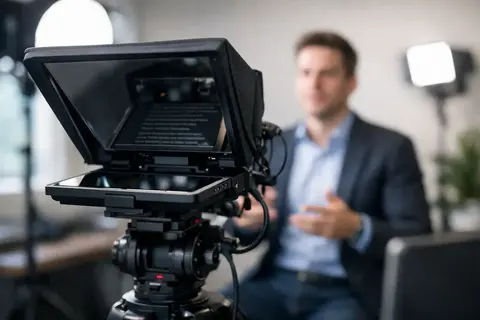
If speaking to the camera takes more time than the filming itself, teleprompters for video recordings are often the piece of equipment that streamlines the whole process. They help keep your gaze on the lens, reduce the number of retakes, and record text more naturally - especially for interviews, promotional videos, training content, and corporate communication.
A teleprompter is not intended only for television. In practice, it is a work tool for anyone who regularly films a speaking person on camera and wants to maintain consistent quality. The more often scripts need to be recorded, the clearer the benefit becomes - fewer mistakes, shorter shooting time, and a more stable result.
In brief
- The teleprompter significantly improves speech accuracy and eye contact with the audience, especially in corporate videos, e-learning, and advertisements.
- Choose the screen size, camera/lens compatibility, and mounting stability based on the distance to the speaker and the frequency of recording.
- Solutions designed for phones are more mobile, tablets provide better readability, and professional monitors are more durable for studio work.
What to choose for different tasks
| Task | Solution | Why |
|---|---|---|
| Short social media clips and simple improvisation | The phone is intended for a teleprompter or a small tablet rig with quick mounting. | Mobility and easy setup are more valuable than high visibility when the script is short and improvisation is allowed. |
| Company speech or product presentation with exact text | Tablet teleprompter or medium-sized monitor with a stable stand. | Better readability and stability reduce errors and reshoots while maintaining portability. |
| Studio broadcasts, conferences, or long lectures | Professional teleprompter with a separate monitor and a sturdy video tripod. | A larger screen and robust construction ensure visibility from a distance and durability in intensive use. |
| A solo content creator who needs to set up equipment quickly and move it frequently | Lightweight, easy-to-assemble teleprompter for a phone or tablet, and a lightweight phone stand. | Quick assembly and low weight make single-person workflow easier without team assistance. |
| Desire to check the teleprompter size before purchase | Try the teleprompter in rental mode before purchasing. | Rental lets you understand the optimal screen size, compatibility with your camera, and the real working speed without a full purchase. |
When teleprompters for video recordings are truly needed
A teleprompter is not mandatory for every project. If you are filming short social media clips with free improvisation, sometimes key points next to the camera are enough. But the situation changes when the text must be precise, legally correct, or simply sound convincing across several takes in a row.
A teleprompter is especially useful for company executives’ addresses, product presentations, e-learning recordings, news-format videos, and advertising copy where wording accuracy matters. It is also a good solution for those who feel insecure on camera. Even experienced speakers tend to lose their rhythm when they have to remember many details at once.
The team-work aspect is also important. If shooting time is limited, a teleprompter helps the director, camera operator, and the speaker themselves work more predictably. Fewer pauses, fewer reshoots, simpler editing.
How a teleprompter works in practice
The construction is relatively simple. The text is displayed on a screen or tablet below the camera, while a special semi-reflective glass shows it to the speaker’s gaze. The camera films through this glass without the viewer seeing the text itself. As a result, the speaker reads while appearing to speak directly into the lens.
This is exactly where quality differences between models appear. A cheaper solution may be sufficient for occasional use, but in intensive work, glass quality, hood light-tightness, mounting stability, and compatibility with different cameras or lenses become important. If the system moves, reflects, or interferes with focusing, the benefit quickly disappears.
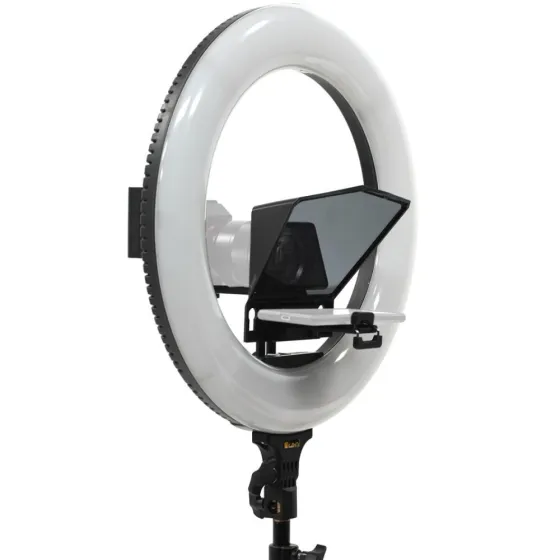 ProductIkan HomeStream Phone Teleprompter Kit (HS-PROMPTER-RL)View product
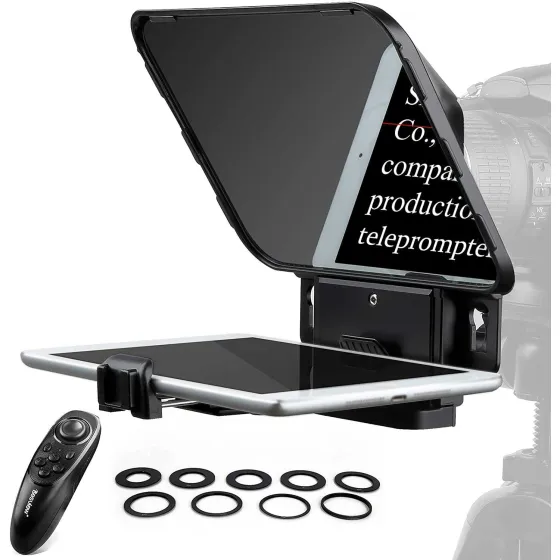 ProductDesview T3 Teleprompter for Smartphones and Tablets up to 11 inchesView product
Main selection criteria
Screen size and readability
One of the first questions is screen size. For smaller close-up recordings, a teleprompter designed for a smartphone or a small tablet is often enough. If the camera is farther from the speaker, for example in a studio or conference room, a small screen will no longer be convenient. The text will need to be set in a large font, scrolling will become awkward, and the speaker’s gaze may start moving too noticeably.
A larger screen usually provides more flexibility, but it also increases size, weight, and the demands on the tripod. That is why you should assess not only visibility, but the stability of the entire setup. A light tripod with a heavier teleprompter and camera is not a good combination.
Compatibility with the camera and lens
A teleprompter must match not only the screen size, but also the filming equipment. Requirements will differ for a compact mirrorless camera and a larger cinema camera. You should check whether the system supports the specific camera height, rail type, and lens diameter.
Wide-angle lenses are also an important point. Some teleprompters with a smaller opening can appear in the frame if you use a very wide focal length. This is a common surprise for users who choose a model based only on price. If you plan to film with wider lenses, the construction size and the distance from the lens to the glass should be evaluated in advance.
Mounting and workflow speed
If a teleprompter is used regularly, not only the image but also setup time matters. Some models assemble quickly and logically, while others require longer assembly, more screws, and greater precision. For a one-off project this may not be decisive, but in daily work every extra minute becomes noticeable.
Particular attention should be paid to whether the teleprompter will be convenient to use alone or in a team. For a solo content creator, a lighter and simpler model is often a practical solution. In a studio environment or commercial shooting projects, a more justified choice is usually a more stable, professional system with greater flexibility.
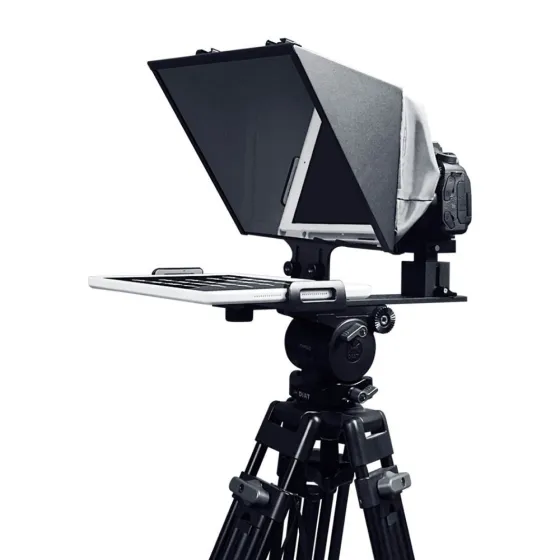 ProductFeelworld TP13 Wide Angle TeleprompterView product
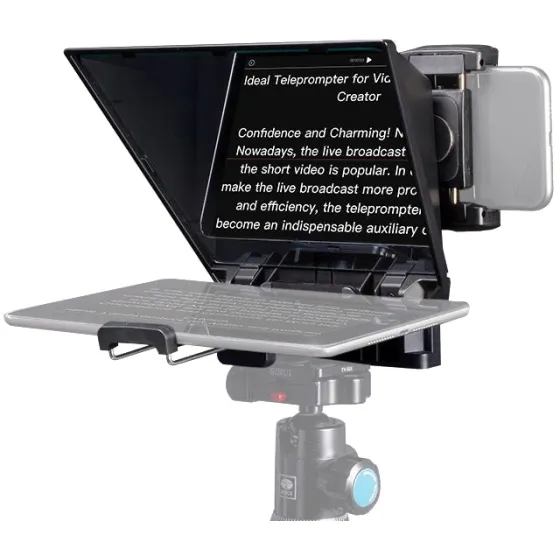 ProductFEELWORLD TP2A Portable Teleprompter for Smartphone and DSLRView product
Teleprompter for phone, tablet, or monitor
Phone solutions
Teleprompters with a smartphone screen are the most affordable and mobile. They are well suited for short scripts, social media videos, simple presentations, and small teams. The advantage is compact size and lower overall cost.
However, there are also limitations. Text visibility will be weaker from a greater distance, and in longer recordings a phone screen does not always provide the most comfortable workflow. If filming is done regularly and with multiple shots, a phone solution often becomes a transitional stage rather than a long-term choice.
Tablet teleprompters
For many, a tablet is the optimal middle ground. The screen is large enough for better readability, while the system is still relatively portable. This format works well for corporate videos, training recordings, interviews, and studio work with mirrorless or lighter video cameras.
You should take into account the tablet’s weight and size, as well as the performance of the specific app. If scrolling lags or the interface is inconvenient, the teleprompter hardware alone will not solve the problem. In practical work, software usability is just as important as the housing itself.
Professional monitor solutions
Larger teleprompters with separate monitors are intended for more serious productions. They provide better visibility, more comfortable work from a greater distance, and often a more durable construction. Such systems are chosen by studios, broadcast recordings, agencies, and teams that need a predictable workflow.
At the same time, you need to allow for more space, more robust tripods, and greater transport requirements. It is a good solution if the teleprompter is an everyday tool, but not always the most sensible option for irregular use.
What determines a natural result on camera
A teleprompter by itself does not guarantee that the speaker will look convincing. The most common mistake is reading too quickly or monotonously. If the text is scrolled mechanically and without pauses, the viewer notices it immediately.
A better result comes when the script is written in spoken language rather than as an official document. Sentences should be shorter, with logical breathing points and emphasis. The placement of the text on the screen is also important - the less the eyes have to travel across the screen, the more natural the gaze.
The correct camera distance is also useful. If the camera is placed too far away and the text has to be enlarged to the maximum, eye movements become more noticeable. Conversely, an overly close shot can amplify any inaccuracy. That is why teleprompter selection should always be evaluated together with the filming scenario, framing, and the speaker’s experience.
Buy or rent
This is a practical question, and the answer depends on how often it will be used. If a teleprompter is needed for one project, a pilot episode, or a specific campaign, renting is often the most rational option. It allows you to use suitable equipment without the full purchase cost and at the same time understand what size and configuration will be needed in the long term.
For regular content production, however, having your own teleprompter provides greater independence. This is especially noticeable for companies, marketing teams, and studios where video recordings happen frequently and without long preparation time. In such situations, access to local equipment, consultation, and backup solutions also becomes important. That is why for some clients the most practical path is to try renting first and then choose a permanent setup.
How not to overpay and still not buy too small
When choosing a teleprompter, it is easy to go to two extremes. One is to buy the cheapest model that technically works but creates obstacles in real use. The other is to choose a system that is too large and heavy, whose potential you do not actually use in everyday work.
The practical approach is to start with three questions. How far from the camera will the speaker be? What camera and what lenses will be used? Will the setup need to be moved often? The answers to these questions usually narrow down the right category very quickly.
If you are not sure whether a specific model will fit your camera, lens, and recording format, it makes sense to consult a specialized equipment partner who understands not only the product category but also real usage scenarios. That is where the difference appears between a generic online purchase and an equipment choice that truly works in the project.
For Master Foto clients, this is often essential, because it is possible not only to compare teleprompters for video recordings in one place, but also to understand how they work together with cameras, tripods, lights, and other filming equipment.
If video content in your work becomes regular, a teleprompter very quickly turns from an extra accessory into a tool that saves time and improves the result in every recording. A good starting point is to choose a model that matches not the ideal future scenario, but your real filming practice today.
Frequently asked questions
How to choose the right screen size for a teleprompter?
Assess the distance between the speaker and the camera — the greater the distance, the larger the screen required. Also take into account the font size and scrolling speed, as enlarged text may require a larger screen or a closer camera.
Will a phone teleprompter be suitable for professional use?
Phone solutions are cheaper and very portable, so they are useful for short formats and mobile work. However, for regular or studio-level work, a tablet or a separate monitor is better, as it provides more comfortable readability from a greater distance.
How does a teleprompter affect your appearance on camera and naturalness?
A teleprompter helps keep your gaze closer to the lens, creating the impression of eye contact. For the result to look natural, the script should be written in spoken language with pauses, and the scrolling speed should be adjusted without reading mechanically.
Can wide-angle lenses fit into a teleprompter setup?
Yes — very wide lenses can show teleprompter details in the frame if the teleprompter is not large enough or the distance is not right. Before purchasing, check the teleprompter opening, the distance from the camera to the glass required, and test the specific lens combination.
How much time should be planned for installation and assembly?
For simple phone/tablet solutions, installation can take only a few minutes, but professional systems require more time and more often team assistance. If the work is regular, choose a model with quick assembly and stable mounts to reduce setup time.
Useful links
- Teleprompters (category) - Category with teleprompters in various sizes — useful for comparison according to the solutions mentioned in the article.
- Stands (category) - The tripod’s durability and compatibility with the teleprompter are emphasized as a critical selection aspect in the article.
- Video tripods (category) - Professional and heavier teleprompter setups require robust video tripods, as the article warns.
- Phone stands (category) - For more mobile phone teleprompters, a stable and portable phone stand is useful, as mentioned in the article.
- NOMA (rent) - The article recommends trying out a teleprompter by renting it before purchasing, in order to assess the size and compatibility in real conditions.