
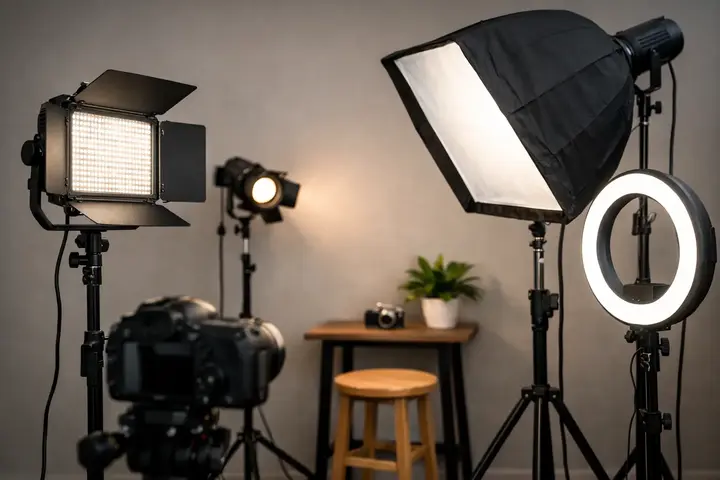
In a small studio, light becomes visible faster than mistakes on camera. If the space is narrow, the ceilings are low, and filming takes place close to the walls, top video lights for a small studio are not simply a matter of power. More important become light control accessories, body size, noise level, color accuracy, and how flexibly a particular lamp can be adapted to different tasks.
That is exactly why a small studio does not always need the biggest COB light or the most expensive kit. In many cases, a better result comes from a more compact and thoughtful setup where each light source serves a specific function. If you shoot interviews, product videos, social media content, or e-commerce demonstrations, the selection criteria will differ slightly, but the basic principle remains the same - in a small space, controllable light wins.
In brief
- In a small studio, controllable light matters more than maximum power — choose COB + softbox or a compact LED panel based on your needs.
- Prioritize CRI/TLCI, quiet operation (fans), dimming quality, and modifier size, not just lumens.
- The optimal setup is: key light + fill light + background accent; renting is a good option if you are still unsure about the configuration.
- Stands and power solutions (batteries/cables) are just as important in a small space as the lights themselves.
What to choose for different tasks
| Task | Solution | Why |
|---|---|---|
| Interviews and talking head | A COB LED light with a softbox as the key light and a compact LED panel as the fill light. | Provides shaping, soft main light with a precise character and even fill that works well in a tight space. |
| Product photo/video on a table | Two compact LED lights from both sides and one top or background light, plus a reflector or light tent. | Uniformity, contrast control, and minimizing reflections are important, which helps present details and materials better. |
| Streaming and YouTube content creation | A compact LED panel or bi-color light as the key light and RGB/LED tubes as background accents. | Quick setup and compact size let you work in a close frame and easily change the visual identity. |
| Commercial video or more serious production | A medium-power COB LED with a quality softbox and grid, plus a sturdy stand. | Gives better light shaping, more accurate color rendering, and the ability to control spill and modeling. |
| Mobility and quick rearrangement | Portable bi-color or RGB lights with battery power and lightweight stands. | Allows you to move the setup quickly without being connected to mains power and reduces cable clutter in a small space. |
How to understand what video lights a small studio really needs
Before looking at models and specifications, it is worth understanding the filming scenario itself. One thing is a talking head at a desk, quite another is a full-body shot, product shooting on a table, or an interview with several people. The larger the area that needs to be lit, the more the need for power or multiple light points increases.
In a small studio, four parameters are especially important. The first is the type of light - panels, COB-type LEDs, or flexible RGB lamps. The second is color accuracy, usually assessed by CRI and TLCI values. The third is the ability to create soft light with a softbox, diffuser, or grid. The fourth is practical use - mounts, power options, controls, and fan noise.
If you plan to film regularly, do not look only at the price. A cheap lamp with unstable color temperature, a weak body, or loud cooling often ends up costing more in the long run because it limits work quality and pace.
Top video lights for a small studio by setup type
LED panels - a fast and compact solution
LED panels are one of the most logical choices for small spaces. They take up little room, can be placed close to a wall or ceiling, and are easy to use without complicated mounting. Panels work well for interviews, streaming, live broadcasts, and content creation where quick start-up is important.
Their main advantage is an even and relatively soft output, especially if the panel already has an integrated diffuser. The downside - compared with a COB light and a large softbox, a panel often gives less pronounced modeling light and fewer reserves when you need to light a larger area or create a more dramatic image.
For a small studio, panels are especially good as fill light, background light, or the main light for content formats where the camera is close to the subject.
COB LED lights - the most flexible option for more serious filming
If you need greater control and the ability to change the character of the light with modifiers, a COB-type LED light is usually the best investment. With one good COB light and the right softbox, you can already build a very high-quality basic lighting setup. This solution is especially useful for interviews, commercial videos, product shoots, and YouTube-format content.
In a small studio, however, compromises must be considered. If the lamp is too powerful and used without control, it will overlight the room and create unpleasant reflection issues. You also need to pay attention to fan noise - in a quiet room it can be heard in the audio recording, especially if the microphone is not positioned optimally.
Usually, a sensible starting point for a small studio is a medium-power COB light rather than a maximum-power model. More important is a quality softbox, grid, and stand, not just a higher wattage.
RGB and effect lights - for accents, not as the foundation
RGB lights are useful if you are creating a modern background, social media content, podcast studio shots, or brand videos with a controlled mood. They let you color the background, add separation from the wall, and quickly change the visual identity without a complicated setup.
However, RGB lamps are rarely the best first choice as the main light source. Users often overspend on color effects before they have secured a stable key light. The practical order is the opposite - first a quality main light, then fill or back light, and only then RGB accents.
What kit works best for a small studio
The simplest and often most effective solution is one key light, one fill light, and one background accent. For example, a COB LED with a softbox as the key light, a compact LED panel for shadow fill, and a small RGB or directional light for the background. Such a setup does not take up too much space and allows you to achieve more professional image depth.
If the budget is limited, you can also start with one quality key light and a reflector. In a small room, this often works better than two weak lamps without shape control. A reflector takes up little space, makes no noise, and helps soften contrast.
For product filming on a table, two compact lights from both sides and one overhead or background light are often useful. Here, evenness and reflection control matter more than high power.
Parameters that really affect the result
You should not ignore lumen or lux figures, but they are not the only guide. You need to look at how the measurements were taken - with or without a reflector, at what distance, and at what beam angle. In practical work, it matters much more whether the lamp can be diffused comfortably and aimed precisely.
Color temperature adjustment is very useful if the room has daylight or other mixed light sources. Bi-color lamps make work easier in such situations, but sometimes they have lower maximum output than daylight-type models. If you film in a controlled room without window light, a daylight lamp may be a stronger and simpler solution.
CRI and TLCI values should be high, especially if you are filming people, cosmetic products, clothing, or commercial content. Poor-quality light can ruin skin tone and make post-production more difficult. This is not worth saving on.
The dimming range is also essential. In a small studio, light is often needed not at maximum brightness, but precisely reduced. If the adjustment is not smooth or the lamp starts flickering at lower levels, it becomes a real problem during filming.
Mistakes when choosing video lights for a small studio
A common mistake is using modifiers that are too large for the space. A large softbox can produce beautiful light, but if there is nowhere to place it at the correct angle, the benefit is lost. In a small studio, a medium-sized softbox with a grid often works better than the largest possible solution without control.
The second pitfall is ignoring stands. Even a good lamp with an unstable or too-short stand creates unnecessary problems. If space is tight, it is especially worth looking at more compact but sufficiently sturdy stands and mounts that let you position the light closer to the wall or above the subject.
The third mistake is an unthought-out power setup. If the studio often needs to be rearranged, battery support or reliable cable management can be just as important as the lamp’s own specifications. In a small room, cables quickly become both a work and safety problem.
Buy or rent
If you film regularly in the same space, buying is usually more logical. It lets you create a stable setup and repeat a previously achieved result more quickly. This approach works well for corporate content teams, podcast rooms, and small e-commerce studios.
Renting is practical if you are not yet sure about the required power, light type, or modifier size. It is also sensible for short-term projects, campaign shoots, or situations where you need a more specific kit than for everyday work. Here, the big advantage is the ability to compare solutions in real work, not just by specifications.
Master Foto full-service approach is especially useful in this regard, because the choice can be based not only on product descriptions but also on practical application and consultation.
What to choose as the first step
If you need a simple answer, then top video lights for a small studio are most often not one specific model, but the right combination. For a start, the safest option is usually a quality COB LED light with a softbox as the key light, or a good LED panel if the priority is compact size and quick setup. After that, the system can be supplemented with a fill light and a small background accent.
The best choice will be the one you can control in your space, in your frame, and at your work pace. If the light lets you work predictably, quickly, and without fighting shadows, reflections, and color problems, then it is the right choice - even if it does not have the most impressive numbers on paper.
Frequently asked questions
Is it better to buy or rent video lights for a small studio?
If you film regularly in one room, buying usually pays off because it lets you create a stable setup. Renting is recommended if you are unsure about your needs or need specific equipment for one-off projects.
How important are CRI and TLCI for a small studio?
Very important — high CRI/TLCI values ensure more natural skin tones and more accurate color rendering. This makes post-production easier and reduces the time spent on corrections in editing.
Can RGB lights be used as the main light?
You generally should not use RGB as the main light because they less often provide optimal color rendering values. RGB is great for accents or background effects, but a COB or a quality bi-color panel is better for the key light.
How do you reduce fan noise from powerful lights?
Choose lights with quieter cooling or position the microphone so it is not directly above the ventilation source. Alternatives are to use acoustic solutions, record audio separately, or switch to lights with a passive cooling design.
Which modifiers work better in a small space?
A medium-sized softbox with a grid often works better than a very large softbox because it is easier to place and control spill. Diffusers, reflectors, and grids provide a way to shape light precisely without needing a large distance.
How do you choose between an LED panel and a COB light for a small studio?
Choose an LED panel if compact size, quick setup, and even fill light are the priority. If you need greater control, stronger modeling, and work with modifiers, then a COB with a softbox is the better option.
Useful links
- Video lights - Renting is an excellent choice if you want to try different solutions for a small studio before buying.
- LED light panels - Panels are the recommended choice as a compact fill or main solution for a narrow space, which is discussed in the article.
- LED light tubes - RGB and effect tubes work great as background accents in small studios to create mood.
- LED lamp power supply - Power solutions and batteries are important for mobility and safe cable management in a small space.
- LED VLOG light - Compact panels and vlog lights are a commonly used solution for quick setup and close-up filming.