
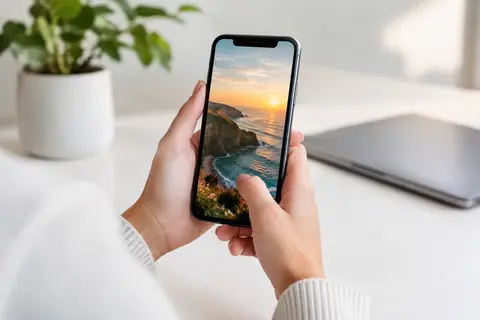
In the first two seconds, a vertical video must give the viewer enough reason not to keep scrolling. This changes not only the editing rhythm, but also how the lens is chosen, the camera is positioned, audio is recorded, and light is arranged. Trends in vertical video formats are no longer just a social media quirk - they have become a practical standard in brand communication, product demonstrations, event coverage, and personal content.
The 9:16 format alone does not guarantee results. A professionally made vertical video starts with a clear objective: should it show a product detail, tell a short story, generate leads, or build trust in an expert? The filming method and the required gear both follow from that answer.
In brief
- Plan vertical shooting during filming itself — do not crop horizontal footage to 9:16.
- Prioritize stability and audio: a tripod/gimbal and an external microphone significantly improve perception.
- Use the right lens and working distance to avoid wide-angle distortion.
- Light should highlight the person or product while keeping natural skin tones; test recordings in the public environment reduce the risk of reshoots.
What to choose for different tasks
| Task | Solution | Why |
|---|---|---|
| Short social media videos (Reels, Shorts, TikTok) | Shoot vertically with one main idea, use a tripod or a lightweight gimbal, one soft LED light, and a lavalier microphone solution. | In short formats, mistakes are visible quickly; a clear structure and stable audio increase viewing retention. |
| Product demos and close-ups | Stable camera position, extra light from the side or backlight, a directional microphone or lavalier, and interchangeable lenses if needed. | Product details require control over reflections, shape, and colors, as well as clear voice or commentary. |
| Event and reportage vertical shots | A dedicated vertical recording with a gimbal or handle, wireless microphones for speakers, and quick exposure adjustments. | In a dynamic environment, automatic cropping ruins composition; a dedicated vertical shot preserves movement and context. |
| Expert short Q&A or interviews | A tripod with soft LED light at a 30–45° angle, a lavalier microphone for the speaker, and, if possible, a telephoto mode or 50–85mm equivalent on a mirrorless camera. | This makes facial proportions more natural, the voice clearer, and captions easier to align with the visual information. |
| Campaigns and larger projects | Use short-term equipment rental (gimbal, studio lights, external monitors, wireless audio systems) and make test recordings before the main shoot. | A larger scale requires extra equipment only when it improves the story; rental lets you test solutions without large investments. |
Trends in vertical video formats: content is built for the frame, not cropped afterward
One of the most important trends is moving away from automatically reframing horizontal footage into a vertical format. In a horizontal interview, a person is often at the edge of the frame, with graphics or another speaker beside them. When this frame is cropped to 9:16, composition, hand movements, and essential context are lost. The result may be technically sharp, but uncomfortable for the viewer.
The vertical frame should be planned from the moment of filming. A person’s face and eyes are usually placed in the upper third, while the lower part should be kept clear because platform controls or text may cover it. If the video will include captions, product prices, or a call to action, space for these elements must already be accounted for in the framing.
This does not mean every project needs two cameras. If one piece of material must be used both horizontally and vertically, you can film in a higher-resolution horizontal frame with a wider composition and intentionally leave room for a vertical crop. However, this solution works for interviews, demonstrations, and calm scenes. In dynamic reporting, sports, or events, a separate vertical frame is the safer choice.
Shorter does not mean simpler
The popularity of short video has created the misleading impression that a 15- to 30-second clip requires less preparation. In fact, mistakes show up faster in a short format. An unclear opening, an unnecessary pause, a poorly heard voice, or a shaky frame reduce watch time within the first seconds.
A structure with one main idea works well in practice. First, the viewer gets a problem, a surprising fact, or a visible result. Then comes a brief explanation or demonstration, and at the end a specific action, such as comparing, signing up, viewing the product, or trying the method. In one clip, there is no need to try to explain everything about a camera, lens, or service. A series, where each video answers one question, is much more effective.
Frame quality starts with stability and light
Vertical video is often filmed with a smartphone, and that is justified - modern phones offer high resolution, fast publishing, and convenient mobile work. However, a professional feel comes not from the device name, but from controlled image quality. A stable frame, clear exposure, and consistent color temperature are more important than a randomly chosen filter.
When filming handheld, small movements are more noticeable in a vertical frame because the viewer usually focuses on one central subject. A smartphone tripod, handle, or gimbal helps produce a calmer image. A tripod is suitable for a talking expert, product reviews, and tabletop demonstrations. A gimbal is useful for walking shots, room tours, and moving action, but it is not necessary in every situation. If movement does not strengthen the story, a fixed shot often looks more convincing.
The lighting trend is not to make the frame as bright as possible. The goal is to separate the person or product from the background and preserve a natural skin tone. One soft LED light at a 30- to 45-degree angle from the face already significantly improves a talking-head frame. Products benefit from additional light from the other side or a subtle backlight accent to emphasize shape and material. Reflective surfaces, such as lens housings, watches, or cosmetic packaging, require special attention because they easily reflect the light source.
Vertical framing demands thoughtful lens choice
A smartphone’s wide-angle camera is convenient, but when filming a person too close, it distorts facial proportions. If possible, it is better to step back and use the main camera or a slight telephoto mode. This creates a more natural perspective and allows the background to look visually calmer.
When filming with a mirrorless or cinema camera, vertical content allows for a wider range of lenses, but the working distance must be considered. An equivalent of about 24 to 35 mm is practical for space, movement, and environmental shots. For portraits or expert interviews, an equivalent of 50 to 85 mm is often more suitable, if the space allows stepping back. A wider aperture helps separate the background, but too shallow a depth of field is a risk if the person moves forward and backward during filming.
Vertical camera mounting requires an L-bracket or a cage with mounting points. This is not just a convenience accessory. The right mount helps balance the camera on a tripod or stabilizer, attach a microphone, monitor, or small light, and maintain safe working ergonomics.
Audio becomes the differentiator
A viewer may accept a slightly grainy image, but rarely accepts an incomprehensible voice. In short vertical videos, spoken text is often the main carrier of information, even if captions are used. That is why the built-in microphone is acceptable only in a quiet, close, and controlled environment.
For a speaking person, a wireless lavalier microphone is a safe choice. It allows freer movement and keeps voice levels even. For desk work, product demonstrations, or off-camera interviews, a directional microphone positioned as close as possible to the speaker is suitable. When filming outdoors, wind protection is not an optional extra - it is a necessity.
Captions remain important because part of the audience starts watching videos without sound. However, captions must not replace clear audio. Automatically generated text often makes mistakes with proper nouns, technical terms, and Latvian grammatical forms, so it should be reviewed manually before publishing.
Authenticity without carelessness
In the vertical environment, an overly sterile advertising shot does not always create the best response. Viewers respond positively to process, work environments, behind-the-scenes moments, and a person practically showing their experience. But authenticity is not synonymous with poor exposure, a dirty lens, or a chaotic message.
For companies, a format works well in which a specialist briefly answers a specific customer question: why use an external microphone, what is the difference between two lenses, how to prepare for event filming, or how to choose lighting for product content. Such a video simultaneously provides value and demonstrates competence. The technical detail should be stated precisely, but without unnecessary complexity.
Practical gear according to project scale
For a basic vertical video setup, a stable tripod, a small LED light, and an external microphone are usually enough. This is a logical solution for regular social media content, short tips, and product demonstrations. If interchangeable optics, greater control over exposure, or higher-quality material for color grading is needed, mirrorless cameras, lenses, camera cages, and audio systems should be considered.
For a larger project, however, a gimbal, wireless microphones for two speakers, a more powerful studio light, a teleprompter, or an external monitor may be needed. Such a kit does not have to be purchased for a single filming session. Master Foto equipment rental allows you to test a specific solution before buying or assemble gear for a campaign, event, or short-term production.
Before filming, it is worth making a short test recording in the intended publishing environment. Check whether the text fits outside the platform interface area, whether the voice is understandable on a phone without headphones, and whether the frame loses quality after upload. These few minutes often save you from reshooting.
The best vertical video is not the one that uses the most equipment. It is the shot in which the viewer immediately understands the main point, clearly sees what matters, and clearly hears the message. Start with one repeatable filming setup, evaluate the result, and expand the kit only when the project truly requires it.
Frequently asked questions
How do you plan framing for vertical video?
Include the main idea in the plan and leave space for captions or a call to action in the upper and lower parts. Frame so that the face or product is in the upper third, and think ahead about where platform interface elements may cover information.
How important is audio in short vertical videos?
Audio is often the main carrier of information, so an external microphone or lavalier solution significantly improves perception. The built-in microphone is acceptable only in quiet and controlled environments; outdoors, always use wind protection.
How do you choose a lens for vertical shooting?
On a smartphone, avoid very close compositions with a wide-angle lens that distorts the face — it is better to step back or use telephoto mode. For mirrorless cameras, a 24–35mm equivalent is suitable for a medium shot, while portraits are better at 50–85mm if the space allows it.
Is it better to use a tripod or a gimbal?
A tripod is enough for fixed speakers, product demonstrations, and tabletop recordings, providing a steady image. A gimbal is useful for moving shots, walks, and room tours, but it is not mandatory in every project — the choice depends on the story.
How should you handle captions and automatic transcription?
Captions are important for users watching without sound, but automatically generated text often makes mistakes in proper names and inflections. Review and correct automatic captions before publishing, especially technical terms and brand names.
Does a short video mean less preparation?
No — in short-form content, mistakes are more noticeable and can quickly lose the viewer's attention. What works in practice is a structure with one clear idea, a quick introduction, and a specific call to action or reason to keep watching the next episode.
Useful links
- Video filming technique - The section is useful for finding the equipment and accessories mentioned in the article — tripods, gimbals, and accessories for vertical filming.
- Mirrorless cameras - The article emphasizes the use of mirrorless cameras for higher-quality vertical filming; this category helps choose a suitable camera.
- Microphones - Audio quality is central to the article — this page helps find lavalier, directional, and wireless microphone solutions.
- LED VLOG gaisma - The article mentions one soft LED light as an effective solution for talking shots; this category offers options to find it.
- NOMA - For larger projects, the article recommends renting equipment; the 'NOMA' section lets you check equipment rental options before buying.