
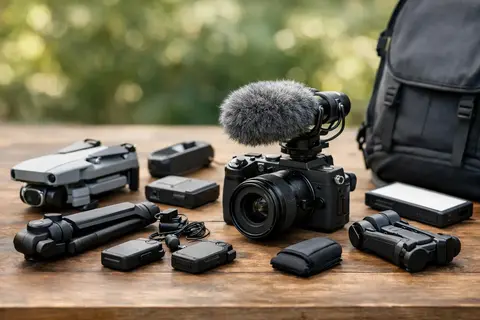
A shooting day comes, and that is exactly when small things most often disappear—the memory card, the audio cable, the spare battery, or simply the right mount. The question of what to take to a shoot is not about filling a bag to the brim. It is about taking exactly what is needed for the specific task, location, and team.
If you are filming alone, the priorities will be different than for a team with a camera operator, sound person, and lighting technician. If an indoor interview is planned, the kit will be more compact than for filming an event or working outdoors in changing weather. That is precisely why good contents of a filming bag are not a universal list, but a structured choice.
In brief
- Organize the bag by priorities: camera, lens, batteries, memory cards, microphone, and light.
- The audio chain (microphone, receiver, cables, headphones) must be brought even for simple interviews.
- Choose stabilization based on the content — tripod for interviews, gimbal for dynamics, monopod for fast movement.
- Bring spare cables, extension cords, windshields, and a portable data backup.
- When buying or renting — keep the items you use often, rent the specialized gear for the project.
What to choose for different tasks
| Task | Solution | Why |
|---|---|---|
| Single-person social media content | Grab: camera with a versatile zoom lens, compact LED light, wireless microphone, monopod or lightweight tripod, spare batteries, and memory cards. | You need a fast setup, mobility, and sufficient image and sound quality without a heavy bag. |
| Corporate interview in a studio | Stable tripod, main microphone or clip-on wireless microphone, one or two proper LED lights with stands, extra storage, and power. | A controlled environment lets you focus on good audio and even lighting, which improves the final material quality. |
| Outdoor reportage and documentary work | Shotgun microphone and windshield, wireless system if needed, extra batteries, portable SSD or several memory cards, rain cover for the equipment. | In outdoor environments, the main risks are wind, weather, and limited power; backup storage reduces the risk of loss. |
| Product video and advertising | A kit with several prime lenses or a precise lens choice, multiple LED lights and light modifiers, a good tripod, and monitoring. | Product filming requires precision, color accuracy, and the ability to control light and details. |
| Event filming with quick reaction | Quick-to-deploy tripod/monopod, spare batteries, compact wireless microphone, portable LED lamps, and easily accessible cables/extension cords. | At events, the priority is speed and mobility, not a finely tailored kit. |
What to take to a shoot first
The first layer is always the basic gear—camera, lens, batteries, and storage media. Without the rest, you can sometimes manage, but without these items, filming simply will not happen. The camera body should be chosen according to the task, not just on the principle of "I’ll take the best one that’s on the shelf." If you are filming dynamic content, autofocus performance and stabilization will be important. If you are working in a controlled environment, codecs, color depth, and connectivity options will play a much bigger role.
A disciplined lens selection is useful. In practice, one versatile zoom lens or two prime lenses is often enough, rather than a full kit. The more glass in the bag, the more time spent changing lenses, the greater the weight, and the greater the risk of forgetting or damaging something. If the shooting scenario is clear, the lens choice can be narrowed down very precisely.
Even experienced content creators make mistakes with batteries. It is not enough to think that one is in the camera and another is in your pocket. What you really need is an estimate—how long the shoot will last, whether there will be a chance to charge on location, whether the camera consumes more power 4K at high frame rates or with an external monitor. The same applies to memory cards. One large card is not the safest solution. It is often wiser to have several tested cards, reducing the risk of losing all the footage at once.
Audio gear is not an add-on
If the image is good but the sound is poor, the material often becomes difficult to use. That is why audio is not a section to add only if there is space left in the bag. For a shoot, you should bring a microphone that matches the situation. For interviews, a wireless microphone or lavalier microphone is usually suitable. For reportage or documentary work, a shotgun microphone is useful. For studio-style recording, the approach may be different, where the priority is a controlled environment and a clean signal.
It is important not only to bring the microphones themselves, but the entire chain around them—receivers, transmitters, batteries, cables, adapters, and headphones for monitoring. Headphones are one of the most commonly forgotten items. Without them, you cannot reliably check whether the signal is too quiet, whether there is interference, friction noise, radio problems, or simply the wrong channel connected.
If filming takes place outdoors, you also need to think about wind. Wind protection is not a minor detail, but a practical necessity. A light breeze that seems insignificant on location can ruin an entire phrase in the recording. Here, compromises usually do not pay off.
Light—how much do you really need
Many people take too much lighting gear because they do not want to take risks. Others, on the contrary, rely on the existing lighting and then struggle with a noisy image, uneven skin tone, and unpredictable color temperature. The right answer depends on the location.
If you are filming an office interview, often one key light and one fill light or reflector is enough. If you are creating product videos or social media content, compact LED lights with quick setup may be needed. For events, however, the main thing is often not power, but mobility and the ability to adapt quickly.
You should bring not only the light sources, but also stands, mounts, and power solutions. Light without a stand or suitable mount cannot be fully used. If you are using more powerful LED lights, you should check whether electricity will be available on location and whether there are enough extension cables. If filming is moving or outdoors, battery power is useful. This is not a matter of convenience, but of workflow continuity.
Stability and camera control
A camera held in the hands does not always mean a lively and authentic image. Sometimes it simply means unstable footage. That is why stabilization should be chosen according to the type of content. For interviews and static shots, a good tripod is often enough. For dynamic video, a gimbal is useful. In some situations, the most effective solution is a monopod, because it is faster than a tripod and lighter than a full stabilization system.
Here, the balance between mobility and control is important. A gimbal looks attractive, but it requires balancing, space in the bag, and time on location. If the shoot is tight and movement is frequent, a simpler support solution may be more practical. Filming equipment does not have to be impressive. It has to work at your pace.
Small items that save the shoot
It is often the accessories that determine whether a shoot goes smoothly. This includes spare cables, USB chargers, extension cords, power splitters, adapters, screws, quick-release plates, tools, and cleaning supplies. None of them looks essential until they are missing.
A lens cloth, air blower, and a minimum set for cleaning the sensor or optics are especially useful when filming outdoors or changing lenses frequently. A rain cover or simple protection from moisture is a very sensible choice in Latvian conditions. The weather can change faster than the shooting plan.
Data safety deserves separate mention. If the shoot is commercially important, it makes sense to bring a portable SSD or another backup storage solution. Copying the material immediately after filming or already during breaks can prevent very costly mistakes. This is especially relevant for events, one-time interviews, and client projects that cannot be repeated.
The filming bag should be adapted to the task
There is no single correct kit for every situation. A one-person team filming social media content will usually be fine with a camera, a versatile lens, a compact LED light, a wireless microphone, a tripod, and spare batteries. Meanwhile, a corporate interview often requires a more organized audio chain, more controlled lighting, and a more reliable tripod system.
For event filming, reaction speed is the priority. There is usually no time for a long setup, so you should bring gear that can be activated quickly. For product filming or advertising tasks, on the other hand, you can afford a more precise kit with more light-shaping tools, additional monitoring, and a more careful lens choice.
That is why, before each shoot, it is worth asking yourself four practical questions: what exactly will you film, how long will you work, how often will you move, and what will you do if a device stops working. The answers to these questions usually tell you what to take to the shoot and what can safely be left at home or in the studio.
Buy or rent for a specific project
Not all equipment has to be owned. If a particular project requires more powerful lighting, a teleprompter, a stabilizer, an additional audio kit, or a second camera body, renting is often more economically sensible than an impulsive purchase. This especially applies to equipment that is needed rarely or only for specific tasks.
On the other hand, the things you use at every shoot—memory cards, batteries, the main microphone, tripod, bag organization, and reliable cables—are usually worth keeping in your own arsenal. The practical boundary is simple: own what you use daily, and rent what you only need for project peaks. This approach helps keep the kit functional rather than overloaded.
If you have doubts about compatibility between the camera, lens, audio solution, or power supply, it is worth consulting a specialized partner rather than relying on guesses. In the case of Master Foto, the advantage is that you can both compare equipment categories in one place and understand what is more economical to buy and what is better to reserve for rent for a specific task.
A good filming bag is not the fullest one. It is the one where each item has its own reason, its own place, and a clear purpose at the moment the camera is already switched on.
Frequently asked questions
How many batteries should I bring for filming?
It depends on the planned length of the job and the power consumption of the cameras/devices; practically, take at least two spare batteries per camera plus power for audio and lights. If you can charge on location, you can reduce the number of spares, but plan that 4K and high frame rates drain power quickly.
Can I manage without an external microphone for an interview?
Usually better not to — a clip-on or wireless microphone gives clearer voice and less background noise. Built-in camera microphones often capture a thinner and noisier signal, which makes editing harder.
How do I choose between a tripod, monopod, and gimbal?
The choice depends on the content type: a tripod provides stability for static shots, a monopod gives quick mobility with partial support, while a gimbal provides stabilized movement in dynamic shots. Consider transport convenience, setup time, and weight in the bag.
How should I handle data safety after filming?
Copy the material to a backup storage device immediately after filming, if possible — in two independent places (card + SSD). This reduces the risk of losing one-time material, especially at events and in client projects.
Is it better to buy or rent specialized equipment?
If a device is used regularly (for example, memory cards, batteries, a basic microphone, a tripod), it is worth buying. For rarely needed or expensive equipment (telephoto lenses, special lights), renting for a specific project is often more cost-effective.
Which small accessories most often save a filming day?
Spare cables, adapters, extension cords, quick-release plates, a cloth, a blower, and windshields for microphones are the most often forgotten but very necessary. They help quickly solve connection, cleanliness, and power problems on site.
Useful links
- Memory cards - More information about memory cards and how to choose them for filming.
- Audio equipment - A section with microphones and audio accessories needed for safe sound recording.
- LED light panels - Selection of compact and stationary LED solutions for light control in the studio and on location.
- Tripods - Stability solutions for interviews and static shots.
- Monopods - Tripods suitable for quick mobility and partial stabilization.
- Backpacks - Bag and organization solutions for carrying equipment without extra weight.