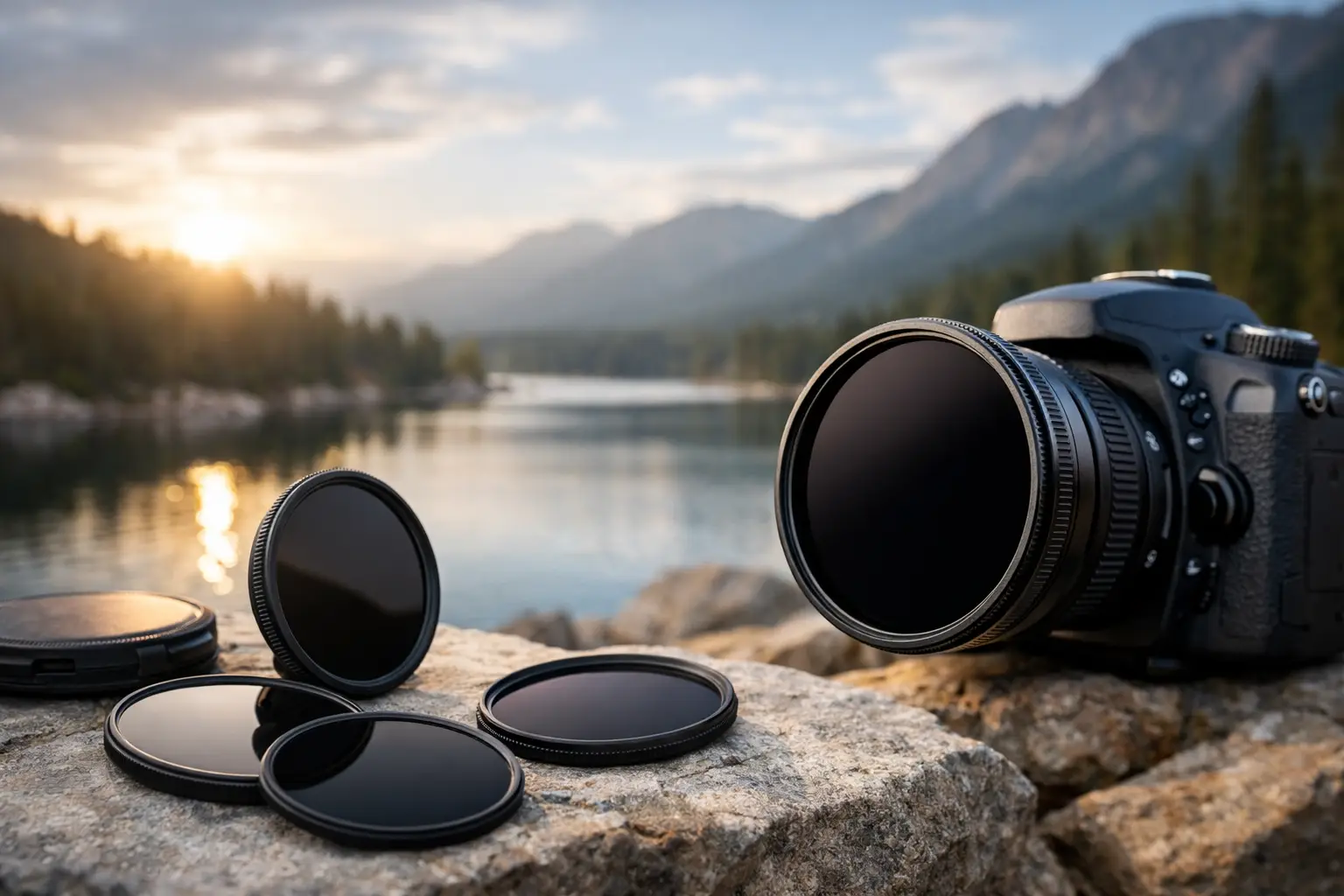
Bright sun, a wide aperture, and too short a shutter speed — this is exactly when the question usually arises of when you need an ND filter. If the exposure is too bright but you do not want to stop down the aperture or change the way motion is rendered in the frame, an ND filter is often the right solution.
In brief
- ND filters reduce the amount of light without changing colors, allowing you to keep the chosen aperture and shutter speed in bright light.
- In photography, they are used to lengthen shutter speed (smooth water, motion blur) or preserve a shallow depth of field in outdoor portraits.
- For video, an ND filter helps maintain the correct shutter speed that matches the frame rate (e.g., 1/50 at 25 fps).
- Choose a fixed ND if optical quality is the priority; a variable ND is more convenient in changing light, but it can cause uneven darkening.
- Pay attention to filter diameter, coatings, and possible vignetting — many lenses may require a step-up ring.
What to choose for different tasks
| Task | Solution | Why |
|---|---|---|
| Daytime landscape photography (smooth water, cloud movement) | Fixed ND 6–10 stops or more, depending on the required shutter speed. | Fixed ND filters usually provide better optical quality and predictability for long exposures without color shift. |
| Outdoor portraits with a very wide aperture (f/1.4–f/2.8) in sunlight | A weaker fixed ND (about 3 stops) or a high-quality variable ND to preserve shallow depth of field. | Reduces the risk of overexposure without sacrificing the chosen aperture and bokeh character. |
| Video shooting outdoors where the shutter speed must stay in line with the frame rate | A high-quality variable ND or a set of fixed ND filters with step-up rings. | A variable ND allows quick adjustment in changing light, but quality matters to avoid the X pattern and color shift. |
| Long exposures in urban environments where you want to 'remove' people from the frame | A stronger fixed ND (6–10 stops or more) and a tripod. | A dense filter allows very long shutter speeds, making moving subjects disappear or blur. |
| Gimbal or run-and-gun video where lighting changes often | A high-quality variable ND with a wide, even range. | Makes it easy to adjust darkening quickly without changing filters, while keeping your usual workflow and frame settings. |
Frequently asked questions
Will an ND filter change colors or contrast?
A good ND filter does not change the scene’s colors because it is neutral by design. However, cheaper filters can introduce slight color shifts or a loss of contrast, so it makes sense to choose quality coatings and a reputable manufacturer.
Which ND filters should I choose for video work?
For video work, a high-quality variable ND is often more practical because it lets you quickly adjust darkening in changing light. However, make sure the filter is optically even to avoid the X pattern and uneven color variation.
How do I know how many stops I need for an ND filter?
The filter strength depends on the goal: about 3 stops is suitable for a light correction in portraits, about 6 stops gives more flexibility for landscapes, and 10 stops or more is intended for very long exposures. Consider the shutter speed and aperture you want in the specific situation.
Can a variable ND create an X pattern or vignetting?
Yes — cheaper or poorly designed variable NDs can show an X pattern at higher darkening levels and create uneven darkening. With wide-angle lenses, you should also watch for vignetting; sometimes fixed filters or using a scale with step-up rings is a better solution.
Why is an ND filter not needed in every situation?
An ND filter solves a specific technical challenge — if you do not need to lengthen shutter speed or keep the aperture wide open, ISO and exposure compensation may be enough. Overusing a filter can make focusing more difficult and reduce image visibility while framing.
Useful links
- ND neutral density filters - A directly related category where you can find ND filters of different strengths.
- Lenses - To evaluate lens diameter and suitability for using a filter.
- Video shooting equipment - Resources and equipment useful for video shooting together with ND filters.
- RENTAL - An option to try ND filters and other equipment before buying.
- Lens filters - A broader filter category with technical specifications and solutions.
An ND, or neutral density, filter reduces the amount of light reaching the sensor without changing the colors of the scene. In practice, this means you can shoot photos or video with the settings required for the creative result, rather than the ones imposed by overly intense light. That is why an ND filter is one of those accessories that initially seems like a niche product but becomes very useful in practice.
When you need an ND filter in photography
In photography, an ND filter is most often needed when the goal is to lengthen the shutter speed or keep the aperture wide open in bright light. In both cases, without a filter the camera often reaches its technical limits.
A good example is landscape photography in daylight. If you want a smooth water surface, a blurred waterfall, or soft, motion-smeared clouds, you need a longer shutter speed. Even at the lowest ISO and a smaller aperture in the middle of the day, the amount of light may still be too much. An ND filter reduces the exposure here and allows you to use, for example, 1 second, 5 seconds, or even longer.
Another typical scenario is outdoor portraits with bright optics. If you are shooting at f/1.4, f/1.8, or f/2.8 and want a shallow depth of field in sunny weather, the camera may reach its maximum shutter speed, for example 1/4000 or 1/8000. If that is not enough, the frame will be overexposed. In such a situation, an ND filter lets you keep the aperture wide open without overexposure.
Another use is creative experiments in urban or travel photography. With a stronger ND filter, you can “remove” moving people from the frame if they move during a long exposure. This is useful for architectural and urban images where you want a static, calm result.
When you need an ND filter for video shooting
In video work, an ND filter is often not just an accessory but a practical necessity. The reason is simple — in filmmaking, shutter speed is usually tied to frame rate so that motion looks natural.
If you are filming at 25 frames per second, a shutter speed of about 1/50 is often used. At 50 frames per second — about 1/100. This approach helps achieve naturally perceived motion blur. But on a sunny day, with such a shutter speed and a wide aperture, the image will almost always be too bright.
Here the ND filter becomes critically important. It allows you to maintain correct exposure without changing the frame rate, shutter speed, or desired aperture. That is why videographers use ND filters very regularly — in outdoor interviews, wedding filming, commercial projects, drone shots, and any situation with bright ambient light.
If you shoot with a log profile or want a consistent image character throughout the scene, an ND filter also helps maintain a stable workflow. Without it, you would have to constantly adjust settings in a compromise mode, which affects both the image aesthetic and the smoothness of editing.
When an ND filter is not needed
An ND filter is not a solution for every situation. If you are photographing indoors, in the evening, or in low-light conditions, it will usually just reduce exposure unnecessarily. In sports and documentary situations, where very short shutter speeds are required, an ND filter is often not a priority.
If the goal is simply to reduce light but the creative intent does not require a wide aperture or slower shutter speed, ISO and exposure setting adjustments are enough. This is an important point — an ND filter is not an “image enhancer” by itself. It is a tool for a specific technical task.
So the question of when you need an ND filter can be answered most precisely like this: when the desired shutter speed or aperture is no longer compatible with the existing amount of light.
Fixed or variable ND filter
When choosing, it is important to understand that ND filters are not all the same. The two most popular types are fixed-density ND filters and variable ND filters.
A fixed ND filter reduces a specific amount of light, for example by 3, 6, or 10 stops. Its advantage is predictability and often higher optical quality. It is a good solution for landscape photographers who work deliberately and know what effect they want to achieve.
A variable ND filter lets you adjust the level of darkening by turning it. This is very convenient for video work and changing lighting conditions because you do not have to screw on multiple filters. However, cheaper models may show uneven darkening, color shifts, or the so-called X pattern at higher density values.
If shooting is dynamic and the light changes often, a variable ND filter is often the more practical choice. If the priority is the cleanest optical result and precise control, a fixed ND filter is usually the safer option.
How strong an ND filter should you choose
The filter strength depends on the task. Weaker ND filters, such as 3 stops, are useful for portraits in bright daylight or video situations requiring moderate correction. Medium-strength models around 6 stops already provide greater flexibility in landscapes and sunny conditions.
Very strong ND filters, such as 10 stops, are intended for long exposures during the day. They are suitable for water, clouds, architecture, and other scenes where you want to turn motion into a flowing structure. But the stronger the filter, the more carefully you need to work with focus, composition, and exposure calculation, because visibility through the filter decreases.
For video users, a high-quality variable ND covering everyday shooting needs is often enough. For photographers who frequently work with long exposures, it usually makes sense to consider more than one fixed filter.
What else to consider before buying
In addition to strength, filter diameter, coating, and mechanical quality are important. The filter must match the thread size of the lens, and if you have several lenses, it is sometimes more cost-effective to buy a larger-diameter filter and use step-up rings.
You should also pay attention to optical quality. A poor-quality ND filter can reduce contrast, create glare, or affect sharpness. In video work, this can be especially noticeable because color shifts between frames make post-production more difficult.
If you shoot with a wide-angle lens, make sure the filter does not cause vignetting. And if you plan to use the filter for both photo and video work, it is worth choosing a model that provides a good balance between convenience and image quality.
Professional advice can be useful here, because the same filter specification can mean a different result in different working scenarios. Especially if the equipment is being assembled for a specific project or you plan to try the equipment in rental first.
Common mistakes when using an ND filter
One of the most common mistakes is trying to solve with an ND filter a problem that should actually be solved with other exposure settings. If there is no need for a slow shutter speed or a wide aperture, the filter may only complicate the work.
Another mistake is choosing too much density. If the filter is stronger than needed for the scene, focusing and framing become inconvenient, while exposure becomes harder to control. This especially applies to beginners who start with very dark filters just because they seem more universal.
The third mistake is overreliance on cheap variable ND filters for video work. Convenience is important, but if the image shows uneven darkening or unstable colors, the final result suffers more than it initially seems.
A practical approach to choosing
If you mostly photograph landscapes, one or two high-quality fixed ND filters with a clearly understood strength will usually be useful. If you film outdoors more often, especially with a gimbal, run-and-gun, or wedding video approach, a high-quality variable ND is usually more convenient.
If you are not yet sure how often you will use it, you do not have to build a large filter set right away. In many cases, one correctly chosen solution for a specific lens and working style is enough. It is practical usability that determines whether the filter really ends up in your bag for every project.
An ND filter becomes necessary not when it is “supposed” to be there, but when it solves a specific shooting limitation. The clearer you understand your photography or filming scenario, the easier it is to choose a filter that works for you rather than becoming just another accessory on the shelf.