
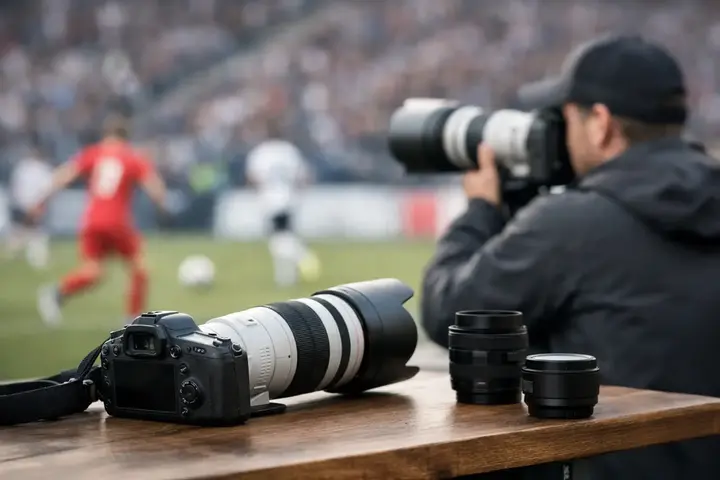
In sports photography, mistakes don’t wait. A player jumps for the ball, a motorcycle exits a corner, a sprinter finishes in a split second - and at that moment the camera either keeps up or the shot is lost. That is why the question of which camera is suitable for sports photography is not about which model has the longer specifications list. It is about which camera can focus quickly in a given situation, shoot at a sufficient burst rate, and maintain quality even in challenging lighting.
In brief
- Choose a camera based on three main criteria: autofocus, burst shooting, and sensor performance at high ISO.
- Mirrorless cameras usually offer better motion tracking and wider AF coverage, but DSLR cameras are still suitable with good ergonomics and telephoto lens support.
- The lens often determines the result — the priority is a suitable telephoto lens (e.g., 70–200mm f/2.8 or 100–400mm) and sufficient brightness.
- Pay attention not only to fps, but also to buffer size and how long the camera can maintain a fast burst in RAW mode.
- If you are unsure, renting or test shooting at practice gives practical insight into how suitable the system is.
What to choose for different tasks
| Task | Solution | Why |
|---|---|---|
| Indoor sports competitions (basketball, volleyball) | Full frame or APS‑C with good high-ISO performance and a fast telephoto lens (e.g., 70–200mm f/2.8). | For shorter exposure times indoors, good noise performance at high ISO and reliable autofocus in low light are needed. |
| Outdoor team sports (football, rugby) | APS‑C or full frame with a telephoto lens (100–400mm or 200–600mm) and reliable continuous autofocus. | The crop factor provides extra reach, which is useful on distant fields, while fast AF and a good buffer help capture decisive bursts. |
| Motorsports and motorcycle racing | A body with solid burst shooting, predictable AF behavior, and telephoto lenses or equipment suitable for panning technique. | In these genres, panning precision, fast response, and a robust buffer are important so you can hold a frame sequence during the action. |
| Children's practices and amateur tournaments | A mid-range mirrorless or DSLR with reliable AF, around 8–15 fps, and affordable telephoto lenses within budget. | These situations do not require the most expensive flagship; overall system flexibility and cost efficiency are more important. |
| Content creation (photo + video) | A hybrid mirrorless camera with good video AF and stability in both modes, plus fast lenses for photo mode. | Many creators use both modes at one event, so a hybrid solution reduces the need for extra gear. |
Which camera is suitable for sports photography for different tasks
There is no single universal answer for all sports. In indoor sports, working at high ISO and precise autofocus under artificial lighting is often decisive. In outdoor sports, longer focal length, good tracking of movement, and a sufficient buffer for longer bursts are often more important. If you photograph children’s training sessions or amateur tournaments, the requirements will be different from reporting on a professional league or motorsport event.
That is why it is worth choosing a camera for sports not by advertising slogans, but by three main blocks - the autofocus system, burst shooting, and sensor performance in low light. Everything else matters too, but it is secondary.
Autofocus is more important than megapixels
In sports photography, the winner is most often not the camera with the highest resolution, but the one that reliably keeps focus on a moving subject. In practice, this means good continuous autofocus, subject recognition, and sufficient focus point coverage in the frame. If the athlete quickly moves from the edge to the center or approaches the camera, a slower autofocus system will start to make mistakes.
Megapixels are useful, especially if cropping is needed, but in sports a range of 20 to 30 megapixels is often enough. It is much more important that the camera focuses accurately even in burst mode and does not lose the subject after the first frames.
Burst shooting and buffer
When a camera promises 20 or 30 frames per second, it sounds impressive, but in practice you also need to look at buffer capacity. If after one short burst the camera stops and writes files to the card, that can be a critical limitation in sports photography. Therefore, you should evaluate not only the maximum fps, but also how long the camera can maintain that speed in RAW format.
At the amateur level, 8 to 15 frames per second is often enough if autofocus is reliable and the buffer is not too shallow. In more professional scenarios, higher speed gives more opportunities to catch the exact phase of movement, especially in volleyball, basketball, motorsport, and track and field.
DSLR or mirrorless camera for sports photography
In recent years, mirrorless cameras have dominated the sports segment because they offer faster subject recognition, wider autofocus point coverage, and often higher burst speeds. That does not mean that DSLRs are no longer usable. Many models still have very good phase-detection autofocus, a durable body, and good ergonomics, especially for working with telephoto lenses.
A mirrorless camera will be the more rational choice if modern tracking, silent shooting, and long-term system development are important. A DSLR can be a good solution if the budget is limited and it is possible to get a quality body together with a suitable telephoto lens at a better price. The trade-off here is usually technological modernity versus total cost.
Full frame or APS-C
Sensor size in sports photography is also not a simple status question. A full frame camera will usually provide better performance at high ISO and a wider dynamic range, which is especially valuable in indoor sports and evening competitions. Meanwhile, an APS-C camera gives additional reach, because the crop factor allows telephoto lenses to be used more effectively.
For example, if you photograph football, motocross, or birds in a sports-like dynamic from a greater distance, APS-C can be a very practical choice. If you work with basketball, handball, volleyball, or events with poorer light, the advantages of full frame become more noticeable. Therefore, in the question of which camera is suitable for sports photography, sensor size should always be considered together with your shooting environment.
What lens sports photography needs even more than the camera
Even a good camera will not be able to show its potential with a slow or unsuitable lens. In sports, a telephoto lens with sufficient focal length and preferably higher aperture is very often needed. A classic solution is 70-200mm f/2.8, because it is suitable for many situations - from indoor sports to reporting from the sidelines. For longer distances, 100-400mm, 200-600mm, or similar ranges become relevant.
If the budget does not allow starting with a professional telephoto lens, you can choose a cheaper zoom with a smaller aperture, but you should expect higher ISO and slower performance in difficult conditions. This is often where the mistaken impression arises that the camera is weak, while in reality the limitation is the lens.
How to choose a camera by level and budget
A beginner does not need a professional flagship right away. If the main goal is to photograph children’s sports, amateur games, or local competitions well, a mid-range camera with reliable continuous autofocus, at least around 10 frames per second, and available telephoto lenses in the system is enough. At this level, it is much more important to invest in a balanced kit than to spend the whole budget on the body.
An enthusiast who photographs regularly and publishes material for media, clubs, or social networks should already look at faster bodies with a better buffer, two memory card slots, and more stable performance at high ISO. At this segment, ergonomics also becomes important - in sports events the camera stays in your hands for a long time, and poorly placed control buttons quickly start to get in the way.
For a professional user, not only speed and focusing matter, but also reliability. Weather sealing, battery life, file writing speed, and service availability are no longer details at this level. They are work requirements.
Is it worth renting before buying
In sports gear, this is often a smart move. Sometimes the specs on paper look similar, but in practice one camera feels natural and predictable in hand, while another gets in the way with menus, the electronic viewfinder, or buffer behavior. If you have to choose between several options, testing in a real training session or competition tells you much more than forums and reviews.
For those who are still not sure about a system, rental is especially rational because the cost of sports photography is made up not only of the body, but of the whole system. If you mistakenly choose a platform with a lens lineup that does not suit you, switching later will be expensive.
Practical scenarios - which camera is suitable for sports photography for you specifically
If you photograph indoor sports, the priority is a full frame or a very capable APS-C body with good high ISO quality and a bright lens. Here, the winning combinations are those that allow you to keep the shutter speed short without excessive noise. In basketball or volleyball, the typical problem is not frames per second, but focusing accuracy in poor light.
If you photograph outdoor team sports such as football, rugby, or floorball by hall lighting, you need fast autofocus and a telephoto lens with sufficient reach. Here, an APS-C body can be a very logical solution, especially if the budget has to remain reasonable.
If your main interest is motorsport, motocross, or cycling, not only continuous tracking focus but also clear controls and predictable burst behavior are important. In these genres, panning is often used, so good results are possible even without the most expensive body, if autofocus and shutter response are stable.
If sports photography is needed for content creation for a club, brand, or media outlet, it is also worth paying attention to video features. Nowadays, one operator often both photographs and films, so a hybrid camera with good autofocus in both modes can be the most practical investment.
What not to overvalue when choosing a sports camera
In-body stabilization is useful, but it is not the main function in sports photography, because freezing motion still requires a short exposure time. Very high resolution is not always an advantage, because it increases file size and the load on the buffer. Exotic shooting modes also rarely determine the final result.
You will gain much more from clear and fast controls, reliable autofocus, and a good lens. In sports, predictability matters. The camera should not make you think about it at the moment when everything is happening on the field.
If you have to make a choice now, the safest direction is to look for a camera with strong continuous autofocus, sufficient burst speed, and a system in which suitable telephoto lenses are available within your budget. You can adjust the rest over time. A good sports kit is not the one that looks impressive in specifications, but the one with which you come home with sharp and usable shots.
Frequently asked questions
Is better autofocus always more important than megapixels in sports photography?
Yes — in sports, AF accuracy and tracking moving subjects are usually more important than very high resolution. Higher megapixels help with cropping or large commercial prints, but if focus is not reliable, high resolution will not fix blurred shots.
How much burst speed is needed for sports photography?
It depends on the sport — for amateur and indoor competitions, 8–15 frames/s is often enough, while more professional genres benefit from 20+ frames/s. However, buffer size and the ability to maintain speed in RAW mode are more important than maximum fps.
Is a mirrorless camera a better choice for sports?
Mirrorless cameras often offer wider AF point coverage, faster subject recognition, and quieter operation, which is an advantage in sports. However, DSLR cameras can still be a successful choice, especially if you already have strong support for a telephoto lens ecosystem.
Should I invest in the body or the lens first?
The lens often determines the final result — a good telephoto lens with the appropriate aperture will improve shots more than a more expensive body with a slow lens. It is recommended to look for a balanced kit and, if possible, invest in a higher-quality lens.
Is it worth renting a camera before buying?
Yes — renting lets you test compatibility with your shooting style, AF behavior, and ergonomics in real practices or competitions. It can prevent expensive mistakes if you later need to change systems or use a different type of lens.
How important is body stabilization in sports photography?
Body stabilization is useful, but in sports it is not a priority because short exposure times are more often used to freeze motion. Stabilization helps more with longer lenses and in video mode than in short-speed photo situations.
Useful links
- Mirrorless cameras - Link to the category for mirrorless cameras, which are mentioned in the article as the more commonly chosen option for sports photography.
- Lenses - The article emphasizes the importance of lenses in sports; this category helps the reader find telephoto lenses and other solutions.
- Sports cameras - This category is useful for readers looking for specialized solutions for sports and action photography.
- Lenses and accessories (rental) - The article recommends trying gear before buying; rental for lenses and accessories is a practical way to test equipment.