
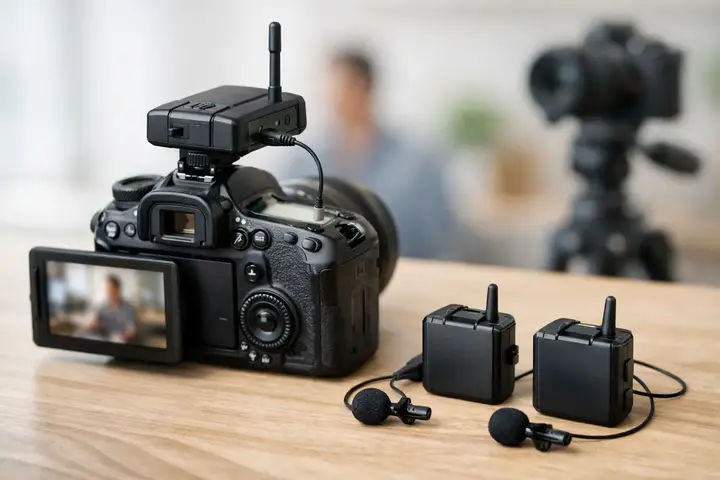
Viewers will still forgive bad video, but bad sound rarely. That is exactly why a wireless microphone for a camera is often the first serious upgrade after buying a camera or lens. If a person’s voice is distant, echoes in the room, or background noise dominates, even a high-quality image no longer saves the result. By contrast, a properly chosen wireless system allows you to film more freely, faster, and more professionally.
In this article, we’ll look at how to choose a suitable solution for different filming scenarios, which specifications are really worth paying attention to, and where paying more does not always bring a real benefit.
In brief
- Choose a wireless system based on use — compact solutions are suitable for vlogs, while interviews and events require a more stable dual-channel system or one with internal recording.
- Check compatibility with the camera (3.5 mm, USB-C, or a dedicated input) and whether adapters are included if you plan to use a phone as well.
- In practice, the priority is signal reliability in real-world conditions, correct microphone placement, and battery life.
- If the work is a one-off or you need to try several systems, consider renting; for regular use, it makes more sense to buy your own kit.
What to choose for different tasks
| Task | Solution | Why |
|---|---|---|
| Vlogs and quick social media content | A compact single-channel system with a built-in microphone or one transmitter with a lavalier clip-on microphone. | Easy to set up and use without unnecessary adjustments; good battery life and quick connection speed up the workflow. |
| Interviews and corporate videos | A dual-channel kit or a multi-transmitter system with the ability to record separate channels and connect lavalier microphones. | Separate recording and lavalier provide cleaner sound, better editing control, and a more professional visual result. |
| Events and reportage with a lot of interference | A stable, proven system with good interference resistance and possible backup recording in the transmitter. | In an environment with many wireless devices and people, reliability matters more than the number of meters listed in the technical specifications. |
| Short-term projects or specialized equipment | Consider renting or short-term hire to try different models before buying. | The differences between audio devices are felt best in real use; renting reduces the risk of making the wrong purchase. |
When a wireless microphone for camera is the better choice
A wired microphone is still a very good solution in many cases. It is simple, stable, and often cheaper. However, the moment motion, multiple people, or work in a public environment is involved in filming, the cable becomes a limitation.
A wireless system is especially useful for interviews, events, talking heads, real estate videos, wedding videography, social media content, and corporate recordings. If the speaker moves around, shows a product, enters and exits the frame, or the camera is placed farther from the person, a wireless solution significantly makes the job easier.
It is important to understand, though, that a wireless system is not an automatic guarantee of quality. It solves the mobility issue, but the final result is also affected by the microphone capsule, correct placement, signal stability, and recording level in the camera or receiver.
How a wireless microphone system works
A typical system consists of a transmitter and a receiver. The transmitter is attached to the speaker or used as a compact microphone, while the receiver is connected to a camera, smartphone, or recorder. In some models, the transmitter itself already contains a built-in microphone; in others, a separate lavalier or clip-on microphone is connected to it.
This is where an important choice begins. A built-in microphone is a fast and convenient solution, especially for short-form content, vlogs, and quick shooting. A lavalier microphone usually allows the sound to be hidden more discreetly and positioned more precisely, which is often important in interviews, conferences, or commercial videos.
In modern systems, internal recording in the transmitter itself is becoming more common. It serves as a safety backup if interference occurs in the wireless signal or the camera does not receive a proper signal. This feature is not mandatory for everyone, but in more professional work it can save you from a very unpleasant reshooting scenario.
Main criteria when choosing a wireless microphone for camera
The first question is not about the brand, but about the use case. The needs of a one-person talking head in a studio will be different from those of a two-person interview at an event or quick social media content on the street.
For one or two speakers
If you regularly film one person, a single-channel system or a kit with one transmitter is enough. If you work with interviews, podcast videos, or dialogues, it is more practical to look at kits with two transmitters right away. This reduces equipment swapping and speeds up work on location.
At the same time, it should be noted that a two-channel system is only worthwhile if the camera or receiver allows both signals to be processed sensibly. In some models, both sources can be recorded separately; in others, they are mixed into one combined track. The second approach is simpler, but gives less control in editing.
Compatibility with the camera
Not every system works equally well with every camera. Some cameras have a 3.5 mm microphone input; other models may support digital audio via USB-C or a special port. If you film with a hybrid camera, camcorder, or mirrorless camera, you need to check not only whether the receiver can be connected, but also how convenient it is to use on the camera body or rig system.
If you plan to use one microphone both with a camera and a phone, it is worth looking at systems with multiple connection adapters. This is practical for content creators who film with a camera one day and record vertical content on a phone the next.
Signal stability and working environment
Manufacturers often specify an impressive operating distance, but in practice it always depends on the environment. In open areas, the distance will be greater, but indoors with walls, crowds of people, or many wireless devices, the signal may become less stable.
That is why, more important than the maximum number of meters, is often the system’s resilience in real filming situations. At weddings, conferences, and public events, the radio environment tends to be difficult. In such work, it is worth choosing a more proven and stable system rather than the cheapest option based only on the technical table.
Sound quality in practice
In the specifications, you may see frequency range, bit depth, and other data, but for the user the most important thing is how the voice actually sounds. Is it clear, is there no digital harshness, does it have enough body in the lower frequencies, and does the system handle sudden sound peaks well.
If you record interviews, courses, or advertising videos, voice timbre becomes very important. For fast social media content, however, a small difference between good and very good sound often is not decisive. There, it is more important that the sound is clean, understandable, and quick to obtain.
Battery life
For short shoots, battery life is usually not a problem, but for events and all-day recordings, it becomes critical. Attention should be paid not only to the transmitter runtime, but also to whether the kit includes a charging case, whether the devices can be charged during filming, and how quickly they recharge.
If you film intensively, a charging case can be much more practical than separate cables. It simplifies logistics and reduces the risk that one part of the kit will remain uncharged right before work begins.
Wireless microphone for camera for different tasks
For vlogs and social media content
Here, a compact system with a built-in microphone, simple connection, and minimal settings usually wins. If filming happens quickly and often alone, the most important thing is to power on, clip on, and start recording quickly. An overly complicated kit in this segment only slows down work.
For interviews and corporate video
In such cases, a system with two transmitters, separate channel recording, and the option to connect lavalier microphones works better. It gives a cleaner visual result and greater control in editing. If filming takes place in the client’s premises or at events, internal recording in the transmitter adds extra safety.
For events and reporting
Here, signal stability, quick setup, and reliable long-term operation are very important. Ultra-compact design will be less important than the system’s practicality and ability to withstand a demanding workflow. If the environment has a lot of interference, the cheapest option can bring more risk than savings.
The most common mistakes when buying a wireless microphone for camera
One of the most common mistakes is choosing based on price alone. A budget system can be perfectly sufficient for hobby-level videos, but in commercial work or non-repeatable events, the risks become more expensive than the initial savings.
Another mistake is ignoring the microphone placement itself. Even a good wireless kit will not deliver a good result if the microphone is placed too low, rubs against clothing, or is hidden incorrectly. Audio quality begins not in the receiver, but at the person who is speaking.
The third mistake is not checking compatibility with existing gear. The camera may not have the required input, the rig system may not have enough space for the receiver, or the audio levels may not be easy to adjust. In practice, such small details create more inconvenience than differences between two similar models.
Buy or rent
If a wireless system is needed regularly, buying makes sense. It pays off faster and allows you to get used to one workflow. However, if the particular project is a one-off, requires a specific model, or you want to compare different solutions before purchasing, renting is a rational choice.
This is especially useful in audio equipment, because differences between models are really felt only in actual use. Sometimes a compact system is enough for everyday content, but a larger project requires a higher-end kit with safety recording and a more stable signal. In such situations, a practical advantage is the ability not only to choose equipment in one place, but also to get консультация or reserve a rental, as offered by Master Foto.
What to choose if you don’t want to make a mistake
If you film for yourself, a small business, or social media, look for a simple, compact system with a good battery and a stable connection. If you work with clients, interviews, or events, two-channel options, internal recording, and reliable performance in more difficult environments become more important.
A good wireless microphone is not the one with the most features. A good one is the one that matches your filming style, works with your existing equipment, and lets you reliably get clean sound without unnecessary struggles with settings. If the choice seems too wide right now, the safest step is to start from your real scenario - what you film, how many people you record, and how high the cost of a mistake is in the specific project.
Frequently asked questions
Will a wireless microphone always sound better than a wired one?
No — a wireless system provides mobility, but not necessarily better sound. The final result is affected by the microphone capsule, placement, signal stability, and the recording level in the camera or receiver.
How do I choose between a built-in microphone in the transmitter and a lavalier microphone?
A built-in microphone is quick and convenient for light vlogs and run-and-gun filming, while a lavalier allows more precise capsule placement and gives better clarity for interviews and professional videos. The choice depends on visual requirements and the level of sound control you need.
What does internal recording in the transmitter mean, and is it necessary?
Internal recording saves the sound locally in the transmitter as a backup in case there is interference in the wireless signal. It is not required for all users, but in professional or once-in-a-lifetime projects it can be a lifesaver.
How can I make sure the system will be compatible with my camera?
Check the camera inputs (3.5 mm, USB-C, or dedicated connectors) and the audio level adjustment options. If you plan to use both a camera and a phone, look for systems with adapters or multiple connection options.
How do I prevent signal drops at events with many wireless devices?
Choose a proven system with good interference resistance, consider indoor test recordings before the event, and use internal recording or backup channels. In real filming locations, many advertised meter ranges are shorter in practice, so stability matters more than maximum distance.
Useful links
- Rode RØDE Wireless GO III RED lavalier wireless microphone kit - An example of a compact wireless kit that can be considered for vlogs and quick filming.
- Rode Wireless GO III + Interview GO lavalier wireless microphone kit (2xTX+RX) with handle - A suitable example of a dual-channel kit for interviews and corporate videos, mentioned in the article as a practical solution.
- Wireless lavalier microphones (category) - A category where you can find lavalier and clip-on solutions recommended in the article for interviews and professional use.
- Wireless audio systems (category) - A broader selection of system types and equipment useful for events and stability requirements.
- Microphones — Sound recording (rental) - The rental option mentioned in the article to try different models before buying.
- RENTAL — photo and video equipment - General rental if the project is short-term or specific solutions are needed for one event.