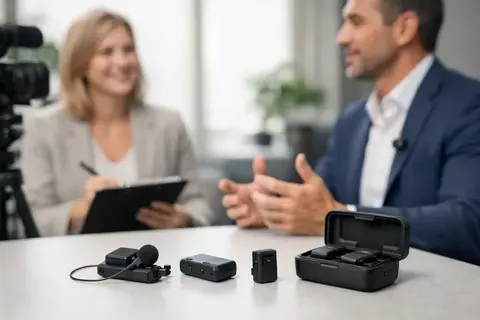
In an interview, the viewer will forgive a less sharp image, but rarely bad sound. That is exactly why a wireless microphone for interview recording is often a more important purchase than the next camera accessory. If conversations take place on the move, in public environments, or with two speakers at once, a wired solution quickly becomes inconvenient, while a wireless system gives much greater freedom to both the operator and the interviewee.
In brief
- A wireless microphone often provides more important sound quality in interviews than additional camera accessories; the choice should be based on the usage scenario, not just the brand or specifications.
- Choose between a compact transmitter (built-in microphone) and a system with a lavalier microphone depending on aesthetics, sound quality requirements, and the need for concealment.
- Priorities: connection stability in real-world conditions, internal recording in the transmitter as a backup, battery life, and compatibility with the camera/phone/computer.
- When filming outdoors, pay attention to windshields and interference management; at events, choose digital transmission systems with good interference protection.
- If a microphone is needed rarely or for testing, consider renting one; for regular use, a personal set usually pays off.
What to choose for different tasks
| Task | Solution | Why |
|---|---|---|
| Short social media interviews or quick reports | Compact wireless transmitter with built-in microphone or one transmitter + receiver; choose a quick-to-set-up kit. | Quick setup and a minimal number of accessories reduce the risk of errors and speed up shooting outside the studio. |
| Corporate interviews, documentary stories, or a commercial video | Dual-channel system with separate lavalier microphone connections and a reliable receiver; preference should be given to models with internal recording in the transmitter. | The lavalier microphone placement allows for more professional concealment of the microphone and provides a more stable level and better quality in different locations. |
| Outdoors or in a noisy public environment (events, exhibitions) | System with digital transmission and good interference management, windshield (deadcat) and a reliable connection over a longer distance. | In the external environment, the risk of interference and wind noise increases; a solution should be chosen that maintains a stable signal and minimizes noise. |
| Mobile team all day on the filming route | A set with long battery life and a charging case; the receivers/transmitters can be charged from a power bank. | Long workdays require the ability to work without frequent charging and to quickly replenish power between shoots. |
| The desire to minimize technical risks in important interviews | System with internal recording in the transmitter and additional spare cables/accessories; check all settings before recording. | The internal recording provides a backup file if the wireless signal is interrupted; spare accessories help quickly fix unexpected failures. |
Frequently asked questions
Do I always need a dual-channel kit (2xTX + 1RX) for interviews?
Not always. If you mostly film one-on-one interviews, a dual-channel kit is useful because it lets you clip a microphone onto both speakers. However, if you regularly record only one speaker, a single-transmitter system is enough, and it is usually more compact and cheaper.
How does the internal recording in the transmitter work and is it necessary?
The internal recording saves the sound directly to the transmitter’s memory as a backup file in case the signal to the camera is interrupted. For interviews with irreplaceable content, this is a very valuable feature, as it provides additional protection against data loss.
How to reduce wind noise when filming outdoors?
Use high-quality windshields (deadcats or special windscreen kits) and place the lavalier microphone behind an appropriate layer of clothing if possible. Proper microphone mounting and a test recording help identify and eliminate noise before the main recording.
How important is connection stability compared to sound 'beauty'?
For job interviews, a stable connection is often more important than nuanced sound color, because interruptions or signal dropouts can make the material unusable. Therefore, choose a system with good interference management and practical operation in real-world conditions.
Can the wireless system be used with a phone, camera, and computer?
Yes, but you need to check the kit compatibility and included adapters; some receivers offer USB-C or Lightning connections, while others use the classic 3.5 mm input. If you work across multiple platforms, choose a more universal kit or additional adapters.
Is it better to buy or rent a wireless microphone system?
If you use the system regularly, purchasing it usually pays off, as it ensures availability and experience with a specific set. If the device is needed only for one project or you want to try several classes of systems, renting is a logical solution.
Useful links
- Boya wireless microphone BOYAMIC 2-01 - The product mentioned in the article (marked with [product id="59552"]) is an example of a compact wireless system that is useful for quick interviews.
- Wireless clip-on microphones - A category where you can find various wireless lavalier systems suited to the usage scenarios described in the article.
- Power supplies - The article mentions a charging solution from a power bank, which is important for long-duration mobile filming.
- Microphone rental - The rental option is mentioned as a recommendation if it is necessary to try or use a professional system temporarily.
- Other accessories - The article recommends checking the test record with headphones and mentions accessories found in this section.
- Microphone accessories - Here you can find wind guards, mounts, and other accessories indicated in the article as important.
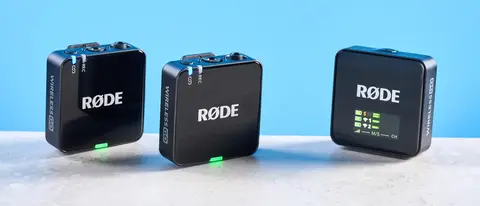
- Rode RØDE Wireless GO III RED lavalier wireless microphone set - The article shows the Rode Wireless Go Gen 3 as an example of a popular wireless system; this link leads to a specific Rode kit variant.
There is no single universally best model in this category. The choice depends on whether you are filming short social media interviews, documentary conversations indoors, event coverage, or corporate videos with multiple locations in one day. That is why the most important thing is not just the brand or price, but the specific use case.
What kind of work is a wireless microphone for interview recording intended for
The first question is simple - how many people will be speaking in the frame at the same time. If you mostly record one-on-one interviews, a kit with two transmitters and one receiver is usually enough. This lets you clip a microphone to both participants and record separate or combined channels depending on the system’s capabilities.
If the recording is for one speaker, such as a company representative, lecturer, or content creator, a single-transmitter system is also sufficient. Such a kit is usually more compact and more affordable. However, in practice, a two-channel system often proves more flexible, because it can be used both for interviews and for individual content.
The environment is also important. Indoors with controlled acoustics and a short distance between the camera and the speaker, the requirements will be different. Outdoors, in urban environments, or at exhibitions, the situation changes - the risk of interference increases, as do wind noise and the need for a stable connection over a greater distance.
Main selection criteria
When choosing a wireless system, it is useful to look not at a single specification, but at the overall ease of use. In interview recording, it is important not only how the sound feels, but also how quickly the system can be set up, how reliably it works, and how easy the material is to process in editing afterward.
Built-in microphone or lavalier connection
Many modern transmitters already function as microphones themselves. This is convenient for quick interviews, because there is no need to look for a separate clip-on microphone, and fewer elements mean less chance of error. Such a solution works well for social media content, event videos, and fast-paced reporting.
However, in a classic interview, a lavalier microphone still often delivers a more professional result. It is easier to hide in clothing, place closer to the mouth, and achieve a more consistent sound level. If you plan to film corporate interviews, documentary stories, or advertising content, a system with a 3.5 mm microphone input will be the safer choice.
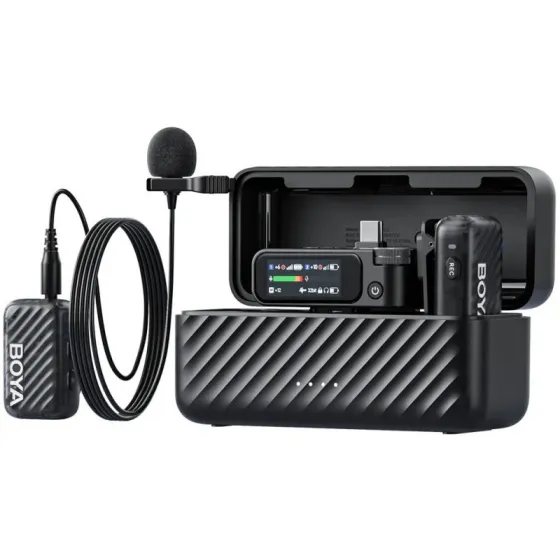 ProductBoya wireless microphone BOYAMIC 2-01View product
Connection stability
The operating distance stated on the packaging sounds impressive, but in practice stability in a real environment is much more important. In interviews, hundreds of meters are rarely needed. More often, what is needed is a reliable signal indoors, among people, near phones, Wi-Fi networks, and other wireless devices.
If you film at events or in public places, pay attention to systems with good interference management and stable digital transmission. This is exactly where cheaper models most often start to lose quality - not in sound tone, but in connection reliability.
Internal recording in the transmitter
This feature has become very important in recent years. If the transmitter can locally record audio to its own memory, you have a backup file in case the signal to the camera or phone drops out for a moment. For interviews with irreplaceable content, this is more than a pleasant bonus.
This is especially relevant for reporting, documentary projects, and client interviews, where repeating an answer is not always possible. If the budget allows, this is a feature worth taking seriously.
Battery life
A short studio interview and a full day of filming are two different situations. If you record several conversations in a row, it is important that the system works for a long time and can be conveniently charged between shoots. A charging case is a very practical solution here, especially for a mobile team.
You should also check whether the receiver and transmitters can be charged during filming, for example from a power bank. This helps avoid unpleasant interruptions on long days.
Compatibility with camera, phone, and computer
Not everyone records only on a camera. Some content is created with a phone, some with a mirrorless camera, and in the case of podcasts or remote interviews, the material also ends up on a computer. That is why it is worth making sure what adapters or connections are included in the kit and whether the system supports your workflow.
Some systems have versions with USB-C or Lightning receivers, while others are oriented toward the classic 3.5 mm camera input. If you work across multiple platforms, a more universal kit will be more convenient in the long run.
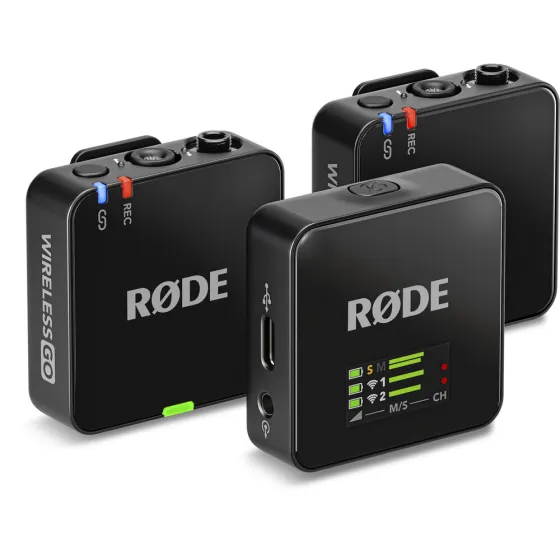 ProductRode Wireless GO III 2xTX+RX 3.5mm USB Type-CView product
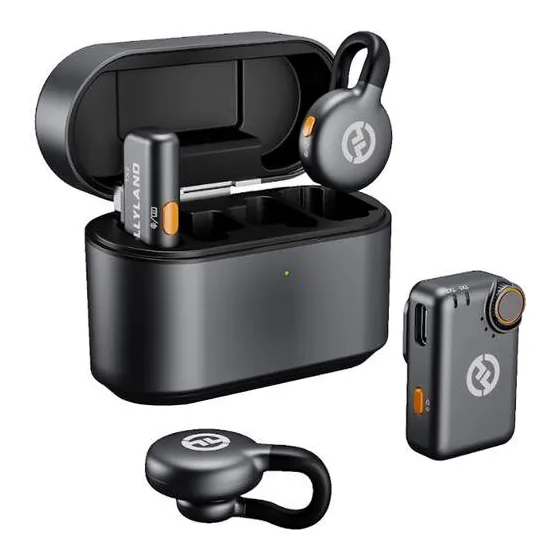 ProductHollyland LARK M2S Wireless Lavalier Microphone Combo Camera RX + USB-C RX + Lighting USBView product
When a compact system is enough and when you need a more serious kit
A compact wireless system is a good choice for content creators, marketing teams, and videographers who value mobility. It is quick to set up, easy to transport, and usually requires fewer additional accessories. For short interview formats, behind-the-scenes videos, and filming outside the studio, it is often the optimal solution.
A more serious kit with separate lavalier microphones, broader control options, and a more professional receiver is better suited to situations where sound quality has direct commercial importance. For example, company presentation videos, television-style interviews, or documentary projects. In such work, what matters is not only clean sound, but also a predictable result in different locations.
There is no strict line between beginner and professional here. In many cases, a semi-professional system with good transmission stability and internal recording will be completely sufficient even for commercial work.
The most common mistakes when choosing a microphone for interviews
The most common mistake is focusing only on the “beauty” of the sound while ignoring usability. In interview work, it matters a lot how quickly you can clip on the microphone, check the level, and start recording. If the system is complicated or slow, it creates stress in real shooting situations and increases the risk of errors.
The second mistake is insufficient attention to accessories. Windshields, lavalier mounts, cable quality, and receiver mounting on the camera affect the result more than it first seems. Even a good microphone outdoors without a quality windscreen can produce unusable material.
The third mistake is excessive economizing on backup solutions. If the interview is important, you need at least basic safety - a spare cable, a charged power bank, or a system with internal recording. Sound problems are usually cheaper to prevent before filming than to try to fix in editing.

What to check before recording
Even a high-quality wireless microphone for interview recording will not deliver good results if the settings are not checked. Before filming, it is worth doing a short test recording with headphones. This lets you immediately hear clothing rustle, too high an input level, or signal dropouts.
Check whether the transmitter is placed under thick fabric or in a way that makes it hit against clothing when moving. If you use a lavalier microphone, pay attention to securing the cable. A small lapse here can ruin an otherwise good interview.
If you are recording two people, it is recommended to keep separate channels rather than summing them into one track right away. In editing, this allows you to adjust levels more precisely and reduce background noise in moments when only one person is speaking.
Buy or rent
If you use a wireless system regularly, buying one is usually justified. This is especially true for content teams, videographers, and companies that record interviews for daily communication or client projects. Owning your equipment means predictable availability and the ability to get used to a specific workflow.
On the other hand, a rental option makes sense if the microphone is needed for a one-off project, a more complex task, or a test before purchase. It allows you to compare different classes of systems in practice and understand whether a compact solution is enough for the specific job or whether a broader professional setup is needed. In such cases, a specialized approach is useful, such as the one provided by Master Foto, where equipment can not only be purchased but also evaluated from a practical usage perspective.
Good interview audio starts not with the most expensive model, but with the right fit for your filming environment, work pace, and the importance of the recording. If you choose a microphone based on real use rather than just the specification table, the result will also be more predictable from the very first recording.