
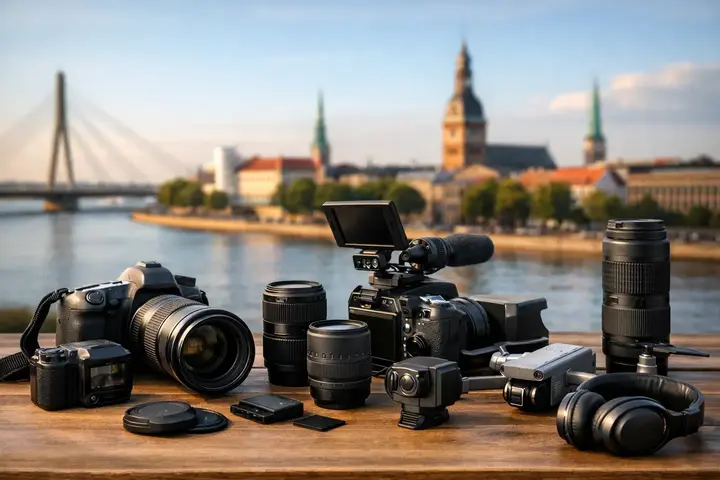
If a full-frame camera, a lighting kit, or a telephoto lens is needed for just one day for a specific project, the first question is usually simple - how much does photo equipment rental cost. The answer is not a single number, because the price is affected not only by the category of equipment, but also by the rental period, the equipment class, the configuration, and how specific your task is.
Photo equipment rental is often the most rational solution if the gear is needed irregularly, for testing before purchase, or for a specific commercial project. This especially applies to more expensive lenses, professional flashes, studio lights, video stabilizers, and other devices whose purchase does not always pay off if use is occasional.
In brief
- The price of rental is affected by the equipment class, rental duration, package contents, and seasonal demand level.
- Evaluate the project requirements (what, where, how long, and what final result) before booking to avoid overpaying or ending up with insufficient equipment.
- Reconsider the package contents — it is often more cost-effective to rent the whole kit than individual items from different sources.
- Include hidden costs in your budget: security deposit, delivery, extra batteries, memory cards, and time buffer.
- Plan ahead and check the completeness of the equipment upon pickup to reduce the risk of extra rental days.
What to choose for different tasks
| Task | Solution | Why |
|---|---|---|
| Studio portrait session | Rent a lighting kit with modifiers, stands, and a backdrop system | In a portrait shoot, the main quality comes from light, not from an expensive body; a kit provides consistent results and saves setup time |
| Wedding or event filming | Include a second camera, a fast lens, a stabilizer, and a professional audio solution in the full kit | Events require redundancy and good sound to ensure continuous and high-quality footage |
| Product photoshoot for e-commerce | A light box or LED panels with diffusers and a macro/standard lens kit | Product photography is mainly shaped by controlled light and proper focus depth, which is often achievable with relatively simple solutions |
| Interview or corporate video | A single-camera kit with a good primary lens, a fifth LED panel, and wireless microphones | For interviews, face/eye-level lighting and reliable audio are important; additional equipment ensures professional sound and image quality |
How much does photo equipment rental cost in different categories
In practice, rental prices are most often set per day, sometimes also for a weekend or a multi-day period. A simpler accessory, such as a tripod or a basic light modifier, costs significantly less than a professional-class camera or a lighting kit with multiple elements.
An entry-level or enthusiast-level camera body rental is usually in the lower price segment than a full-frame professional body with high burst shooting speed, advanced autofocus, or video features. Similar logic applies to lenses. A standard zoom lens will be more affordable than a fast prime lens, a tilt-shift model, or a long telephoto lens for sports and nature photography.
In studio equipment, the price is determined not only by the device itself, but by the whole set. One flash with a stand and softbox will be one level of solution, while a multi-light system with radio synchronization, backgrounds, and additional modifiers will already be a different budget item. In the video segment, it is similar - a simple microphone or LED panel will cost less than a gimbal, teleprompter, or a professional audio recording kit.
If you need an indicative price overview, smaller accessories and simpler supplementary equipment often start from a relatively low daily rate. Meanwhile, camera bodies, high-quality lenses, and specialized studio or video equipment already fall into a medium or higher rental cost range. That is why the most correct way to understand the cost is to look not at one universal figure, but at the specific category and intended use.
What affects the rental price the most
The first factor is the value of the equipment. The more expensive and specific the gear, the higher the daily rate will be. This is logical - professional bodies, high-end lenses, and cinema or studio equipment mean a larger investment, higher wear risk, and often more precise maintenance as well.
The second factor is the rental term. A one-day rental is almost always more expensive, calculated per day, than a longer period. If you need the equipment for several days, a weekend, or an entire project, it is often possible to get a better price-to-use ratio. That is why it is not worth looking only at the daily rate - the whole schedule must be considered.
The third factor is configuration. A camera without a lens is one cost item, but a camera with several lenses, spare batteries, memory cards, a tripod and lights is a completely different solution. Sometimes it is more advantageous to rent the whole set from one provider rather than collect components separately from different places.
Equipment demand is also important. Seasonally popular models, the latest releases, or specific products may be both more expensive and less available. This is especially noticeable during event, wedding, and commercial filming season, when the most popular bodies and lenses are booked in advance.
When renting is more advantageous than buying
If you use the equipment once or twice a month, a purchase is not always justified. This applies not only to price, but also to maintenance, storage, and model obsolescence. Equipment that sits on a shelf every day does not earn money, but it still loses value.
Rental is especially sensible in three situations. First, when a project requires specific gear that you do not use every day, such as a macro lens, a powerful studio flash, or a video stabilizer. Second, when you want to test a model before buying it. Third, when additional units are needed for a team - a second camera, an extra light, or another lens for a backup scenario.
For professionals, rental also helps smooth cash flow. There is no need to invest a large sum at once in gear needed only for a specific client project. For companies and marketing teams, this is even more important, because equipment is often needed within the framework of a campaign, event, or one content day.
How to understand how much photo equipment rental costs for your specific task
The right question is usually not just about price. It is more practical to find out what configuration is needed and how long it will be useful. If you are filming an interview indoors, one camera will not be enough for the full budget - you will also need a lens, sound, light, memory cards, and power. For a portrait session in a studio, the main cost block may not be the camera, but the lighting system and accessories.
That is why before booking it is worth defining four things - what you will film or photograph, under what conditions, for how long, and what the final result is. This determines whether a compact solution will be enough or whether a full professional setup is needed. This approach protects against two common mistakes: overpaying for overly powerful equipment or, on the contrary, saving in the wrong place and suffering in quality.
Hidden costs that many do not include
The rental fee itself is not the only budget element. Often you also need to consider the security deposit, delivery or pickup, extra batteries, storage media, and accessories that are not included in the basic package. Sometimes the client realizes this only when receiving the equipment, when it turns out that work still lacks seemingly small but critical items.
Another cost area is time. If the equipment is taken without a clear plan, the number of rental days can stretch out. This often happens when the filming schedule, locations, or team coordination have not been prepared. Precise planning can reduce costs just as effectively as choosing cheaper equipment.
Responsibility for the condition of the equipment must also be taken into account. Professional rental means that the equipment is issued checked and in working order, but on the client’s side proper use and safe transport are required. That is why before work it is worth checking not only the contents of the bag, but also whether there is someone on the team who really knows how to work with the specific equipment.
How not to overpay, but choose correctly
The cheapest option is not always the most advantageous one. If the chosen lens cannot provide the required frame, or the light output is too weak for the room, the savings disappear within the first hour. Therefore, the price comparison should be done together with technical suitability, not separately from the task.
A good principle is to start with the result, not the equipment name. If you need product photos for e-commerce, the requirements will be one thing. If you need to film an event in low light, the needs will be different. With this approach, it is easier to understand where it makes sense to invest more and where a simpler configuration is enough.
A consultation before booking is also useful. At a specialized rental point, you can quickly find out whether your planned combination is balanced, whether any critical accessories have been forgotten, and whether there is a more rational solution for the specific project. Here, the value is not only in issuing the equipment, but also in expert support. This approach is appreciated by both experienced operators and companies that use equipment irregularly.
How much does photo equipment rental cost if you need more than a camera
Many clients start with the idea of renting only a camera, but in practice a project often requires a full set. For wedding filming, this may mean a second body, a fast lens, a stabilizer, and an audio solution. For studio portraits, it will be light sources, modifiers, a background, and stands. For a company content day, not only a camera is needed, but also microphones, LED lights, and perhaps a teleprompter.
In such situations, costs rise, but efficiency also increases. A bundled rental from one partner is often more practical than searching for individual units in different places. If you need both photo and video equipment, a specialized center, such as Master Foto, allows you to find the gear in one place and get a clear picture of the total budget.
If your question is how much photo equipment rental costs, the most accurate answer always starts with the task, not the first line of a price table. The clearer you are about what you will photograph or film, the easier it is to find a configuration that works for you and does not make you pay for unnecessary extras.
Frequently asked questions
What are the main factors that determine the rental price?
The main factors are the equipment value, rental duration, and package contents. Seasonal demand and availability for a specific model also have an impact.
How can you get a better daily rate?
Book for a longer period, for example several days or a week, because discounts for long-term rental are usually available. Renting a kit from one supplier is also often cheaper than combining individual items.
Which costs are often not included in the initial quote?
Security deposit, delivery and return costs, as well as extra batteries and memory cards, are often not included right away. Possible extra rental days should also be considered if the work schedule falls apart.
Is renting more cost-effective than buying?
Renting is more cost-effective if you use the equipment rarely, want to try a model, or need specific devices for one project. For regular or intensive use, buying may pay off, but it requires additional calculation for maintenance and depreciation.
How can you make sure you receive all the necessary equipment?
Create a checklist before booking, including lenses, backup power, storage media, stands, and the required cables. When you pick it up, check the equipment together with the provider and record any missing items on the spot.
How should you plan the work to reduce extra costs?
Prepare a detailed filming or photoshoot schedule, check the location and crew availability, and prepare a technical checklist. Careful planning reduces the risk that the equipment will need to be extended or changed during the day.
Useful links
- Video stabilizatori - Point to options for stabilizer rental if the project requires additional motion stability.
- Video filmēšanas tehnika - Additional information about video equipment categories and options for building a rental kit.
- Kameras - Link to the camera category to assess how body type affects the rental price.
- Atmiņas kartes - A reminder to include memory cards in the rental budget as a commonly needed accessory.
- Statīvi - Tripods are often a basic requirement for studio and video work, and including them affects the package price.
- Piederumi kameru zibspuldzēm - Information about flash accessories and modifiers that affect the total cost of a studio rental.