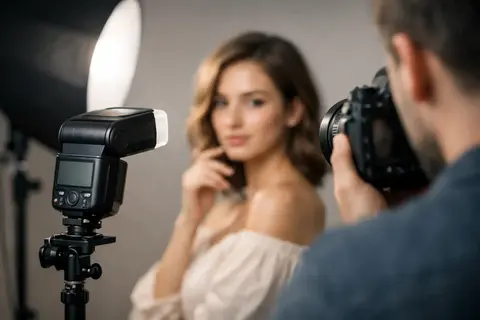
In portrait photography, lighting mistakes are immediately visible. Facial skin looks flat, eye shadows become too harsh, and the background either disappears into darkness or gets lit in the wrong place. That is why a flash for portrait photography is not just an accessory - it often determines whether the shot looks professional or simply technically well exposed.
In brief
- Choose between an on-camera flash and a studio/battery monoblock according to mobility and power requirements.
- Prioritize a small power reserve and stable recycling time to maintain rhythm and consistency in portrait series.
- Use both TTL and manual control depending on the job — TTL for fast work, manual mode for controlled studio sessions.
- Light modifiers (softbox, octabox, beauty dish, reflector) affect the final look more than the flash model itself.
- If you're not sure — rent the equipment or try several configurations before making a big investment.
What to choose for different tasks
| Task | Solution | Why |
|---|---|---|
| Rapidly changing environments / events | Compact on-camera flash with TTL and HSS support | TTL speeds up exposure adjustments in changing conditions, and HSS helps control background exposure in daylight or at planned apertures. |
| Commercial or fashion portraits in the studio | Studio flash or battery monoblock with precise manual control and a wide range of modifiers | Offers consistent power, fast recycling, and allows precise shaping of the relationship between key, fill, and background light. |
| Outdoor full-body portraits or working with large softboxes | Powerful battery-powered monoblock or battery-powered studio flash | Provides the necessary power to light a large modifier or overpower daylight while maintaining mobility. |
| Home / portrait photography lessons | Mid-power camera flash or available studio kit for rent | Reduces initial costs, allows you to learn the differences between TTL and manual mode, and assess the necessary modifiers. |
| Working with children or spontaneous portraits | Flash with fast recycling time and stable pulse temperature; for TTL use when a fast rhythm is needed | Particularly important are pulse stability and a fast recycle time, so as not to miss the moment and to maintain a consistent skin tone throughout the series. |
Frequently asked questions
Is it better to choose TTL or manual mode for portraits?
TTL is more convenient in dynamic work and at events, where you need to react quickly to changes in lighting. Manual mode provides better repeatability and precision in controlled studio sessions, especially when working with multiple light sources.
How important is flash power in portrait photography?
Power determines how large a modifier you can use effectively and whether you will be able to overpower ambient light. A practical approach is to choose a solution with a small power reserve to avoid constantly operating at maximum output.
Which light modifiers are the most advantageous for portraits?
Softboxes and octaboxes usually provide soft, flattering light for facial portraits; a beauty dish works well in beauty portraits where more structured facial modeling is needed. Reflectors are an inexpensive and effective way to fill in shadows without additional flash.
Why are recycling time and color temperature stability important?
Processing time affects frame rhythm — slow processing can disrupt the session flow and break the pose sequence. Color temperature stability ensures a consistent skin tone throughout the series, making post-processing easier and preserving a professional look.
Is a studio flash mandatory if I mainly shoot on location?
Not necessarily — if mobility is a priority, a good portable or battery flash is often a better solution. However, if you regularly use large modifiers or shoot in bright daylight, a battery monoblock with more power may be necessary.
How to choose a suitable flash without overpaying?
Base your choice on the main work needs: where most sessions take place, how controlled the environment is, and whether you plan to expand the system in the future. If possible, try the equipment through rental to make sure it is compatible with your styling and work pace.
Useful links
- Studio flashes - The article mentions the advantages of studio flash and explains how they provide power and repeatability for commercial portrait sessions.
- Flashlights with rechargeable batteries - The text discusses mobility and the need for battery life outside the studio, so this category helps find solutions.
- Flashlight lighting - The article compares different flash classes and their suitability for portrait scenarios; the category brings together a broader lighting offering.
- Camera flashes - The text examines the role of camera-mounted flashes in mobile and fast-paced work, so the link helps find suitable models and accessories.
- Batteries for flash units - The article mentions that battery life and backups are essential in location photography, so the link leads to suitable battery solutions.
- Softbox - Light modifiers are widely mentioned as a more important element than the flash itself, and softboxes are the more commonly recommended solution for portraits.
- NOMA - The article recommends a rental approach to try the equipment before making a major investment; this page leads to the rental section.
If you photograph portraits regularly, the choice between a compact on-camera flash and a full-fledged studio light is not just a matter of price. The difference lies in control, the character of the light, the pace of work, and how predictable the result can be in different situations.
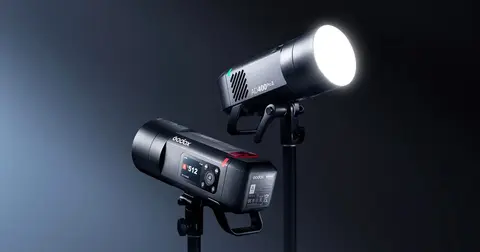
Which flash for portrait photography suits your work
There is no single universal answer, because the portrait genre covers very different scenarios. In one case, you are photographing business portraits in an office with limited time and space. In another, you are creating a creative session in a studio with light modifiers. In yet another, you are working on location, where battery life and mobility matter.
If mobility is the priority, a reportage-style flash is a logical starting point. It is lightweight, quick to set up, often supports TTL automation and high-speed sync. Such a solution works well for portraits in small spaces, at events, on a wedding day, or in situations where there is no time to build the lighting for long.
If stable power and broader lighting options are more important, the usual preference is a studio flash or a battery monoblock. They allow you to work with larger softboxes, octaboxes, beauty dishes, and other modifiers. The light becomes softer, more even, and more repeatable, especially in full-body portraits or when working with groups.
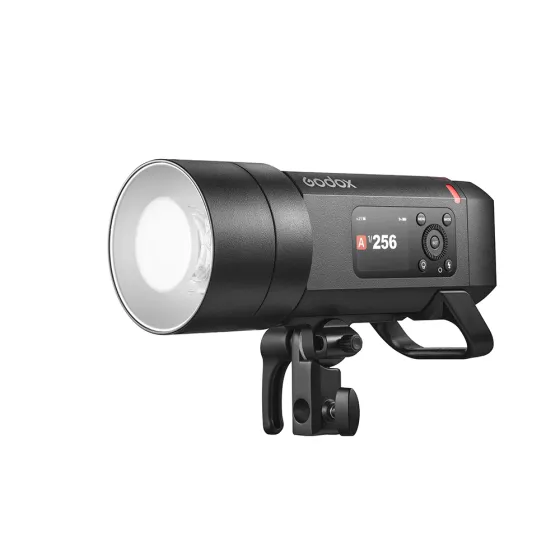 ProductGodox Witstro AD400 Pro II TTL battery flash light 400WSView product
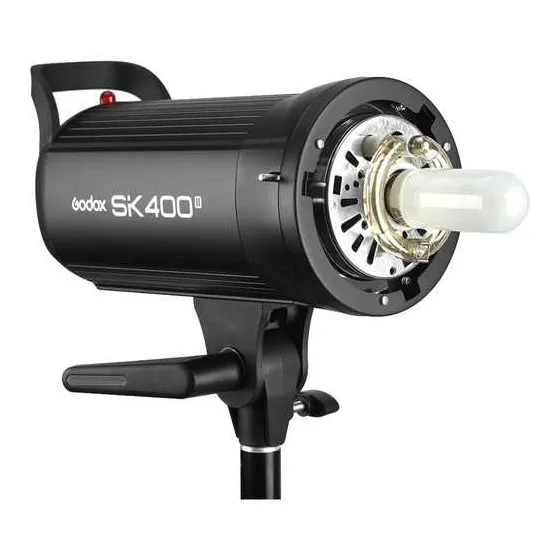 ProductGodox SK400II Studio FlashView product
On-camera or studio flash
This is the first practical choice most photographers face. An on-camera flash is usually more affordable, more compact, and more flexible in everyday work. It works well if you use the flash off-camera with radio triggers and small light modifiers. In portraits, this is often much more effective than shooting with the flash directly from the camera axis.
However, compromises must be expected. A smaller head means a smaller light source, and therefore harsher shadows if reflectors or diffusers are not used. Power also has limits, especially in daylight or when shooting through a large softbox.
A studio flash gives you more headroom. It recycles faster between shots, provides more power, and often offers more precise power adjustment. This is especially valuable in commercial portraits, where the client needs a consistent result throughout the entire series. The downside is lower mobility, greater weight, and often higher overall costs, because stands, modifiers, and transport also need to be considered.
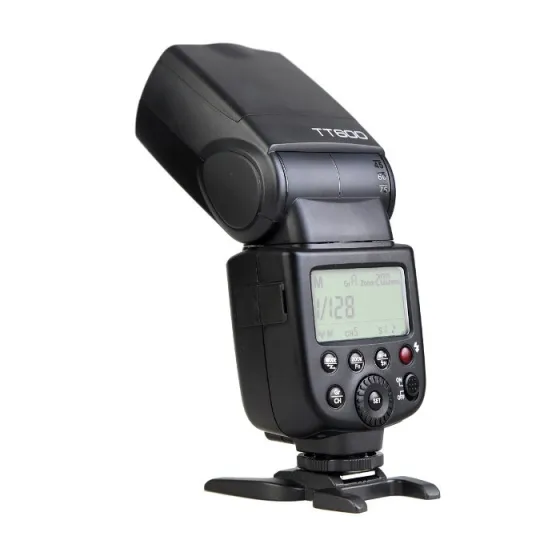 ProductGodox Speedlite TT600 Flash with 2.4Ghz Master/Slave FunctionView product
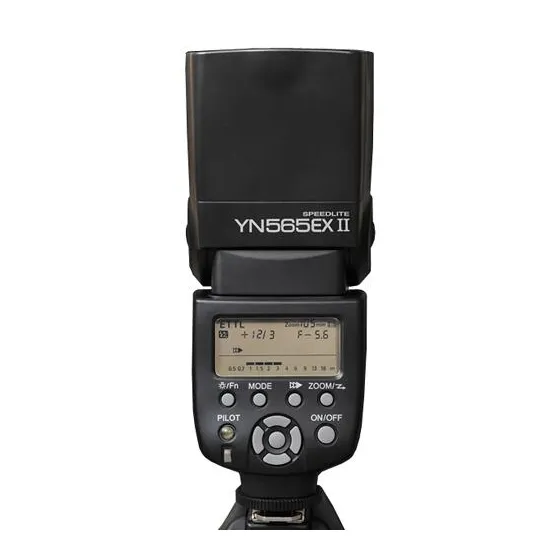 ProductYongnuo YN-565CII zibspuldze CanonView product
Power is not everything, but it sets the limits
When choosing a flash for portrait photography, many people first look at power. That is correct, but only partly. Power determines how easily you can overpower ambient light, how large a modifier you can use, and how far you can place the flash from the subject.
For small head-and-shoulders portraits indoors, a compact solution is often enough. But as soon as you need a full-body portrait, light through a large softbox, or work in bright daylight, power reserve becomes critical. If the flash is constantly running at maximum power, recycle time slows down and the risk of overheating increases.
In practice, this means a simple principle - it is better to have a small power reserve than a model that only works in ideal conditions. Especially if portrait photography is not a one-time experiment, but a regular part of your work.
TTL or manual control
In portraits, you often hear that manual mode is the only professional approach. That is not entirely accurate. TTL automation can be very useful in dynamic work, such as events, fast corporate sessions, or shooting in changing environments. It speeds up the process and reduces the technical load at moments when the contact with the person in front of the camera matters more.
In studio and controlled sessions, however, manual power control is usually the safer choice. It allows you to achieve consistent exposure from frame to frame and precisely shape the relationship between key, fill, and background light. If you work with multiple flashes, manual control will almost always be more predictable.
An optimal option for many users is a system that offers both modes. Then you can adapt to the specific task instead of building your workflow around the limitations of a single mode.
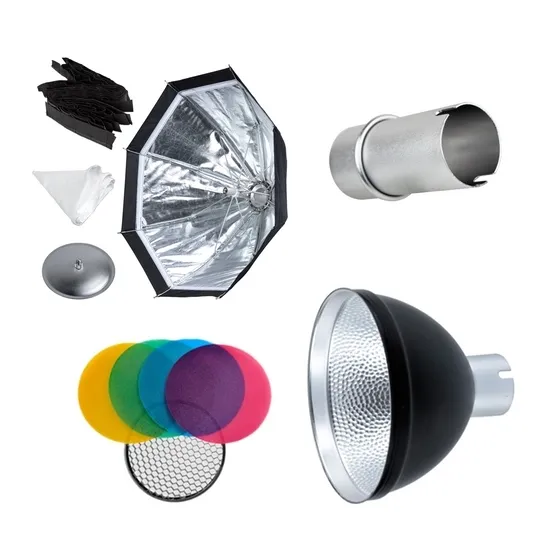 ProductGodox AD200 Accessoire kitView product
Light modifiers affect the portrait more than the flash itself
In portrait photography, the result is rarely determined only by the flash body. Often, the greater importance lies in how the light is diffused and directed. With a bare flash, you get technically strong but visually harsh light. For the face, that is usually not the most flattering solution unless you are aiming for a deliberately high-contrast aesthetic.
A small softbox is a good starting point for individual portraits. An octabox gives softer and more even light, especially in beauty portraits. A beauty dish helps create a more contrasty, structured facial modeling. A translucent umbrella is a quick and simple option, but it spreads light more widely in the room, so control is lower. Reflectors help fill shadows without a second flash.
That is why it is worth thinking about equipment selection systemically. Not just about the flash, but also about mounts, available modifiers, radio control, and whether the kit will be easy to expand later.
Color temperature, recycle time, and stability
These parameters do not always look impressive in the catalog, but in real work they are very important. If the color temperature changes from one pulse to the next, it will be harder in post-processing to maintain a consistent skin tone. This is especially important in beauty, fashion, and commercial portraits.
Recycle time affects the pace of work. If the model changes pose but the flash is not yet ready for the next shot, the rhythm is lost. When photographing children, events, or spontaneous portraits, this is a crucial factor. Pulse stability during burst shooting can also be decisive.
A cheaper solution is not necessarily bad, but in the budget class you more often have to expect greater fluctuations in power, charging speed, and build quality. If portraits are a commercial service, technical predictability usually pays off.
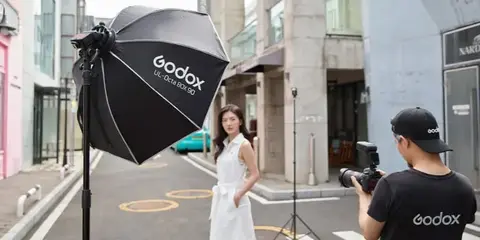
Studio and location work require different solutions
In the studio, you can afford larger equipment, mains power, and broader modifiers. This makes precise light shaping easier and allows you to work for long periods without thinking about remaining battery life. If portraits are mostly photographed in one controlled location, this is often the most efficient scenario.
On location, weight, size, and setup speed come to the fore. A battery monoblock or a powerful portable flash gives greater freedom, especially when shooting outdoors or in a client’s premises. At the same time, you need to think about transport, spare batteries, and the impact of weather conditions. Not every good studio solution will be convenient for outdoor work.
For those who work in both modes, the most logical path is often to build a kit within one system. For example, use one radio control ecosystem for different types of flashes. This reduces complications and allows you to combine equipment depending on the specific project.
How to choose without overpaying
A common mistake is to buy the most powerful solution right away without evaluating the real use case. If you photograph portraits in a home studio or small rooms, a huge power reserve may remain unused. On the other hand, a too-simple flash will quickly become a limitation if you start working with larger modifiers or client assignments.
That is why it is worth basing the choice on three questions. Where most sessions will take place, how controlled the environment will be, and whether you plan to expand the lighting system in the future. If the answers are clear, the right segment usually becomes understandable without unnecessary guessing.
In many cases, the most sensible step is not to buy the most expensive kit right away, but to test a specific solution in practice. If you have the opportunity to compare different power levels, modifiers, and working scenarios, the choice will be safer. This is where a rental approach is also useful, because it allows you to assess whether a particular flash for portrait photography really matches your style, work pace, and client assignments.
If in portrait photography you want not just to light a person, but to deliberately shape facial volume, mood, and the emphasis of the gaze, the right flash pays off quickly - not only technically, but also in the result the client sees.