
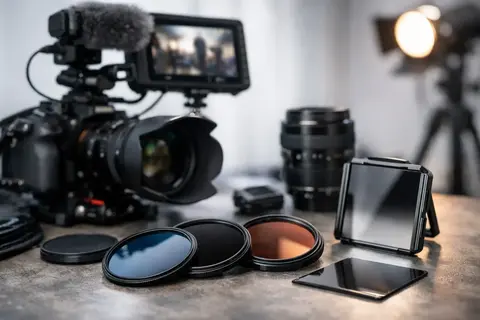
If a shot on a sunny day is overexposed, but you do not want to increase the shutter speed because the natural motion blur will disappear, the question of which filter to use for video shooting becomes very specific. A filter is not just an accessory for a “prettier picture.” In many cases, it is a technically necessary tool for maintaining proper exposure, controlling reflections, and achieving a predictable result.
In video shooting, filter selection almost always starts with one of three needs - reducing the amount of light, reducing reflections, or creating a specific visual effect. That is why there is no single universal filter that suits all projects. What works for documentary shooting outdoors will not always be suitable for an interview in a studio or an automotive video with many reflective surfaces.
In brief
- The main tool for controlling video exposure is ND filters — they allow you to maintain the desired shutter speed and aperture in bright light.
- A polarization (CPL) filter eliminates glare and saturates the sky, but reduces light and can create an uneven effect with wide-angle shots.
- A UV/protective filter primarily serves as lens protection; choose a high-quality filter or do not use one if maximum image clarity is the priority.
- Variable ND is convenient for run-and-gun work, but beware of the risks of X-pattern and color shift when choosing a high-quality model.
- Diffusion/soft filters give a cinematic look, but they should be used in moderation — too strong an effect can look forced.
What to choose for different tasks
| Task | Solution | Why |
|---|---|---|
| Bright daylight, you want to preserve cinematic motion | ND filter (fixed or variable ND) | Reduces incoming light, allowing you to maintain the selected shutter speed and aperture without overexposure. |
| Reflections on glass, water, or a car body interfere with the composition | Polarizing (CPL) filter | Reduces glare on non-metallic surfaces and can enhance sky saturation, which often cannot be fully corrected programmatically. |
| Filming in dusty or risky environments where lens protection is required | A high-quality protective filter/UV filter or removal, if the environment is safe | UV/protective filter protects the front lens surface, however a cheap filter can degrade image quality. |
| Portraits, commercials, or music videos where you want to soften the look | Diffusion / soft filters (special/mist types) | Gently reduces digital sharpness, smooths skin texture, and adds a subtle halation to light sources. |
| Fast-paced workshop or changing lighting conditions (run-and-gun, gimbals, drones) | High-quality variable ND filter | Allows quick adjustment of darkness without changing filters, but low-quality models that can cause an X pattern or color shift should be avoided. |
| Working with multiple lenses and want to reduce the kit cost | Buy a larger-diameter filter and use step-up rings | Reduces the number of filters needed and logistics on set, especially when using different lenses. |
Which filter to use for video shooting in different situations
In practice, the ND filter is most often used for video needs. If you shoot with the classic approach, where the shutter speed is approximately double the frame rate per second, for example 1/50 at 25 fps, in bright daylight the exposure will usually be too high without a filter. If you want to preserve a wider aperture and a cinematic motion character, an ND filter is the first solution.
Meanwhile, a polarizing filter is useful when the problem is not the amount of light, but reflections on glass, water, car bodywork, or wet surfaces. It can also make skies more saturated and foliage more contrasty, but in video work it must be used carefully. Excessive polarization can look unnatural in some scenes, especially if you are using a wide-angle lens.
A UV filter does not significantly improve video quality. It more often serves as protection for the front lens element against dust, scratches, and splashes. For some operators it is a daily protective layer, while others avoid it to reduce the number of extra glass surfaces in front of the lens. Both approaches are understandable if you choose a quality filter and know the conditions in which you are shooting.
Effect filters, such as diffusion or mist-type filters, are a separate category. They soften digital sharpness, make the light gentler, and can give the image a more cinematic character. These filters are not a technical necessity for every project, but they can be very valuable for shooting commercials, portraits, and music videos.
ND filters - the main tool for controlling video exposure
If you need a short answer to which filter is most often used for video shooting, the answer will be an ND filter. It reduces the amount of light reaching the sensor without changing the color balance as drastically as other improvised solutions. It allows you to keep the chosen shutter speed and aperture even in very bright environments.
Fixed ND filters are available in different strengths, such as ND8, ND64, or ND1000. The higher the number, the more light is blocked. Their advantage is a predictable and stable result. The drawback is that you need to change filters depending on the lighting conditions. This is convenient in controlled shooting, but less convenient in dynamic run-and-gun work.
Variable ND filters are popular among videographers because they allow quick adjustment of darkening by rotating the filter ring. This speeds up work, especially when shooting in changing light or with a gimbal. However, cheaper models may show unwanted issues - color shifts, uneven darkening, or the so-called X pattern effect at maximum settings. That is why quality is especially important when choosing a variable ND.
If you shoot with a drone or an action camera, ND filters have another practical function - they help preserve more natural motion, because in bright conditions the shutter speed on these devices often becomes too short without a filter. As a result, motion looks jittery and digitally sharp. A properly chosen ND filter significantly reduces this problem.
How strong an ND filter should you choose
There is no universal formula, but in practice ND16, ND32, and ND64 are often enough for shooting in daylight. If you are filming in very bright sun with a wide aperture, a stronger filter may also be needed. If you move between shade and sun, a variable ND may be more effective than a set of several fixed filters.
The lens diameter is also important. If you use several lenses, it is often more cost-effective to buy a filter in the largest needed size and use step-up rings. This reduces total costs and simplifies kit logistics on set.
When to choose a polarizing filter for video shooting
A polarizing filter is not mandatory for every project, but in certain situations it does what cannot be fully corrected in post-production. It reduces reflections on non-metallic surfaces, lets you see through a shop window or over water, and helps organize a scene where too much visual noise is caused by light reflections.
In product videos, automotive shoots, architectural shots, and nature scenes, a polarizer can be very valuable. However, keep in mind that it also reduces the amount of light. If you are already shooting in low light, a polarizing filter may create an unnecessary compromise between ISO and exposure.
With wide-angle lenses, you need to account for an uneven effect in the sky. One part of the frame may become significantly darker than another because the polarization effect changes depending on the angle to the sun. In photography this is sometimes acceptable, but in video it often looks distracting. That is why it is better to evaluate a polarizer based on the specific scene rather than use it automatically.
Is a UV filter needed in video work
As an image-quality enhancer, the UV filter is no longer decisive in modern digital video practice. So the question is not whether it will improve colors or sharpness, but rather the working conditions. If you shoot in dusty environments, near the sea, at events with high mechanical risk, or frequently change operators, a protective filter may be a justified choice.
At the same time, a cheap or optically weak UV filter can cause reflections, loss of contrast, and ghosting in backlight. This is where the main compromise arises. Protection is useful, but only if the filter itself does not become an image-quality problem. In professional practice, people more often choose a high-quality protective filter or use nothing at all if the environment is safe and the priority is a maximally clean optical path.
Effect filters - when they really help
Not every project needs a diffusion filter, but in a certain aesthetic it is a very powerful tool. Such filters gently reduce digital sharpness, smooth skin texture, and give light sources a slight halation. This works especially well in portraits, commercials, music videos, and narrative short films, where a technically perfect sharp image is not the only goal.
Moderation is important here. Too strong a diffusion effect can look forced, especially in 4K or 6K recording, where the viewer expects a detailed image. Many operators start with a weaker intensity and only then decide whether a stronger effect is needed. If you are not sure, renting is a sensible way to test the character of the filter before buying.
How to choose a filter based on the camera and working style
Filter choice is determined not only by the scene, but also by the camera, lens, and shooting pace. If you work with a hybrid camera without a built-in ND filter, an external ND is often a must-buy. If you use a cinema camera with internal ND, the need for a screw-on ND decreases, but a polarizer or diffusion filter may still be relevant.
For run-and-gun work, quick adjustment is important, so a variable ND is often the most logical choice. In commercial or staged shooting, where the light is more stable and quality requirements are higher, many prefer fixed ND filters. If you work with multiple lenses and a matte box system, it may also make sense to look at square or rectangular filters, not just classic screw-on options.
You should also pay attention to coatings, frame material, and filter thickness. Poor anti-reflective coating causes problems in backlight, while an overly thick frame can cause vignetting with wide-angle lenses. These are not details only for professionals. They are things that show up in the final material.
The most common mistakes when choosing filters
The most common mistake is buying a filter based only on price. In video work, filter optical quality is just as important as lens quality, because the filter sits directly in the light path. If the filter causes color shifts or reduces contrast, you will have to compensate with extra color correction work, and that does not always fully succeed.
Another mistake is expecting one filter to solve every situation. An ND does not solve reflections the way a polarizer does, and a polarizer does not replace a strong ND filter in very bright sun. The third mistake is ignoring lens diameter and system compatibility. As a result, the filter fits one lens but not the rest of the kit.
If you will use filters regularly and in different projects, it is worth viewing them as part of a working system rather than as a separate small item. This applies both to buying and renting. For Master Foto clients, this is often the most practical path - first understand the task, then choose the appropriate category, and only then a specific model.
If you need to make a quick decision, start not with “which filter is the most popular,” but with “what problem do I need to solve in the frame.” That is where the right filter choice and a more stable result in shooting begin.
Frequently asked questions
Is an ND filter always the best choice for filming video outdoors?
ND filters are often the first solution in bright daylight, because they allow you to keep your chosen shutter speed and aperture. However, if the problem is reflections, a polarizer may be more suitable. The choice of filter should be based on the specific problem in the frame.
Fixed ND or variable ND — which should you choose?
Fixed ND provides predictable, stable results and often higher optical quality. Variable ND is more convenient in changing conditions and run-and-gun work, but can produce an X pattern and color shift at maximum settings, especially in cheaper models.
When to use a polarizing filter in video shooting?
A polarizer is useful when the primary goal is to reduce reflections on non-metallic surfaces or make the sky more saturated. Caution is needed with wide-angle lenses, as the effect can be uneven and in video it can interfere with composition.
Does a UV filter improve video quality?
In modern digital video, a UV filter usually does not improve image quality; it more often serves as physical protection for the front lens. Choose a high-quality filter, otherwise reflections, ghosting, and loss of contrast may occur.
How to avoid the X-pattern and color shift in a variable ND filter?
To reduce the risk, choose a high-quality variable ND from a trusted manufacturer and test the filter at different darkness levels. If an X-pattern or shift still appears, consider using a fixed ND filter or combining it with other solutions.
How to choose the filter size if you are working with multiple lenses?
A practical solution is to purchase a filter in the largest required diameter and use step-up rings, thereby reducing the total number of filters. This simplifies logistics and is often a more economical solution for a kit with multiple lenses.
Useful links
- ND neutral density filters - The basic solution for exposure control in bright daylight — related to the ND filter recommendations in the article.
- CPL polarizing filters - The article discusses the use of polarizers to reduce glare and saturate the sky.
- Protective filters - UV/protective filters are mentioned as optical protection against dust, scratches, and splashes.
- Special filters - The article mentions diffusion and mist-type filters that give a cinematic character.
- Soft filters - Soft/mist-type filters are mentioned as a means of softening the skin and rendering light more softly.
- Objectives - The article recommends paying attention to the lens diameter and step-up solutions when working with multiple lenses.
- NOMA - It is recommended to rent effect filters to test their character before purchasing.